

Treadmill Pace Calculator
The treadmill pace calculator converts belt speed into minutes per mile and kilometer. You can also start with a target pace or work out the speed needed to cover a distance in a chosen time. Compare the exact answer with the settings your treadmill actually offers, then check how rounding changes your workout.
Your treadmill mile pace
MIN / MILECalculating your treadmill pace…
Your Treadmill Setting
— mph
Choose the increment used by your treadmill.
Your Workout
—
Compare Treadmill Speed Settings
See how one or two presses of the speed button change your pace and workout.
| Belt Speed (MPH) | Min / Mile | Min / Km | Distance In 30:00 | Try It |
|---|
“Nearest setting” is rounded to your selected increment. It is a calculation, not a recommended exercise intensity. Check the speed range supported by your machine.
At Your Entered Pace
Elapsed time at a constant belt speed. Warm-up, acceleration, pauses and cooldown are not included. These are not race-performance predictions.
milepacecalculator.com/treadmill-pace-calculator/
How the treadmill pace calculator converts belt speed
Your mile pace is 60 divided by treadmill speed in mph, so a setting of 6 mph gives ten minutes per mile and 8 mph gives 7.5 minutes, written as 7:30. You can use the same calculation with metric units by dividing 60 by km/h to get minutes per kilometer. For instance, 10 km/h gives 6:00/km, but entering that display number as 10 mph represents a substantially faster speed. Checking the unit first saves you from comparing two very different workouts simply because their belt settings use the same digits.
Minutes/mile = 60 ÷ mph
Minutes/km = 60 ÷ km/h
The result assumes the belt runs at the displayed speed throughout the period you’re calculating. Acceleration, slowing down and pauses can change your actual session average. A warm-up followed by faster intervals needs separate calculations for each part if you want to total the session accurately.
If you only need to change units, the Pace Converter gives the equivalent pace and speed. This treadmill tool adds workout goals and nearby belt settings, which helps when the machine’s controls don’t match an exact mathematical answer.
Choose the speed or pace you need
You can start with Speed if you already have a belt setting in mind, then choose mph or km/h and a time or distance goal to complete the workout calculation. If your plan gives a target such as 9:30 per mile, Pace mode lets you enter the minutes and seconds and choose the matching pace unit instead. There is also a finish-time option for a question such as the speed needed for 1.5 miles in 12 minutes. In that case, your distance and target duration supply the information needed to work backward to belt speed.

The speed increment should match the treadmill controls. A machine that moves in 0.1 mph steps can’t usually hold an exact setting such as 6.3158 mph. The calculator rounds to an available setting and shows nearby alternatives so you can compare the result.
That comparison matters when your target is close. A 9:30 mile needs about 6.316 mph. At 6.3 mph, the pace is roughly 9:31; at 6.4 mph, it’s about 9:23. Neither is exactly the original target, but you can see the difference before starting.
Treadmill pace chart and examples
A belt setting of 5 mph gives a twelve-minute mile; 7.5 mph gives an eight-minute mile. These are steady-speed equivalents, with no incline correction added.
| Speed, mph | Pace per mile | Pace per km |
|---|---|---|
| 3.6 | 16:40 | 10:21 |
| 5.0 | 12:00 | 7:27 |
| 6.0 | 10:00 | 6:13 |
| 7.5 | 8:00 | 4:58 |
| 8.0 | 7:30 | 4:40 |
| 10.0 | 6:00 | 3:44 |
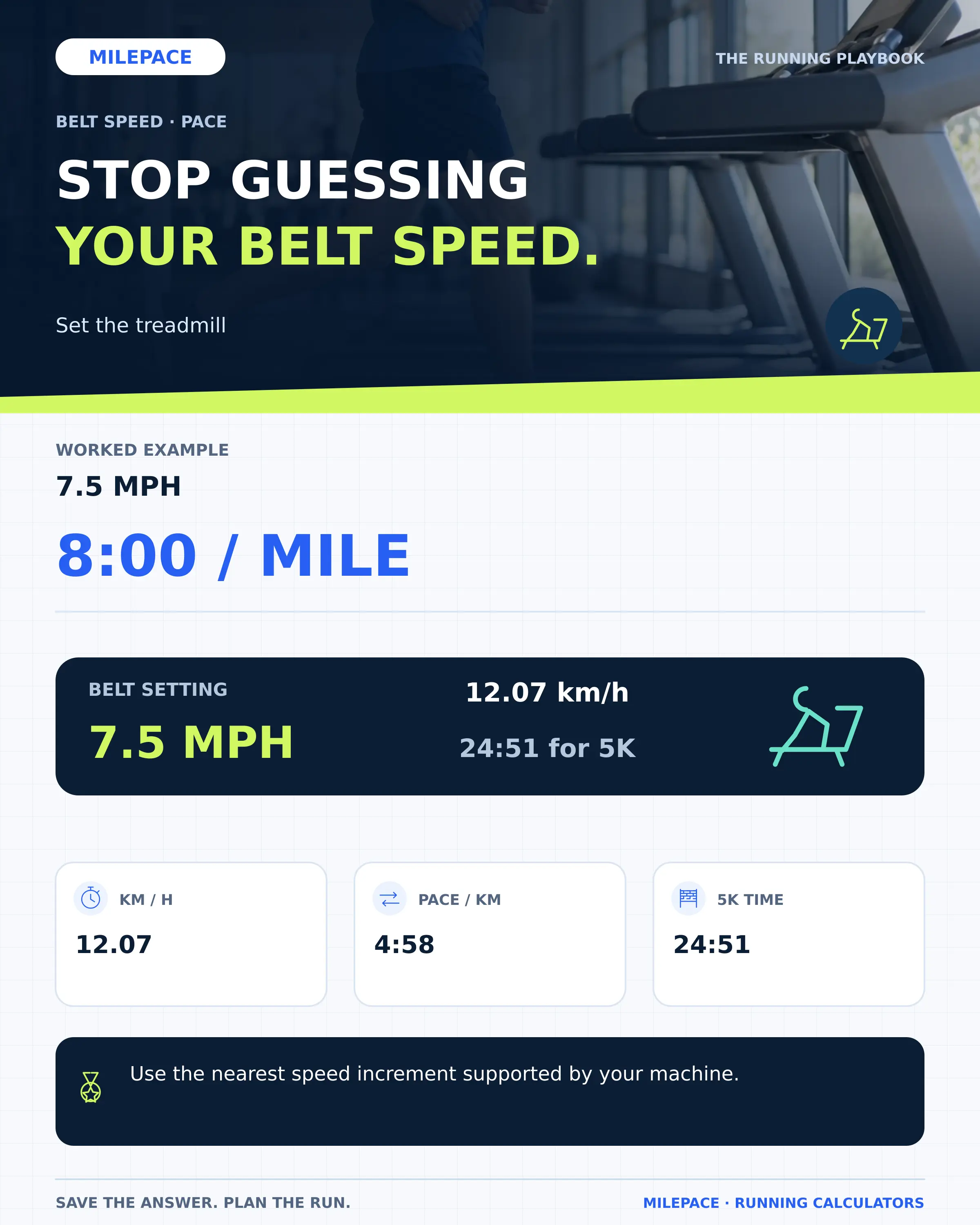
For a 1.5-mile run in 12 minutes, divide 1.5 by 0.2 hours to get 7.5 mph. The equivalent is about 12.07 km/h. If your machine only offers 0.1 km/h increments, compare the nearby settings instead of assuming the displayed pace will be identical.
You can use the 1.5-mile calculator and pace chart for more finish-time examples. Its track checkpoints are useful outdoors, while the speed column translates the same constant pace into a treadmill setting.
Plan workout time and distance
You can find distance by multiplying speed by hours, or find duration by dividing distance by speed, with the time unit kept consistent throughout. Thirty minutes is half an hour, so a steady 6 mph session covers three miles during that period. At 7.5 mph, three miles takes 24 minutes, while a 20-minute session covers 2.5 miles. Naturally, which result matters depends on your goal: you can keep the planned duration fixed or keep the distance fixed, then see how the other value changes with belt speed.
When you select a rounded belt setting, the fixed goal stays important. With a distance goal, a slower setting takes longer. With a time goal, the same slower setting covers less ground. Read the appropriate result rather than comparing the two as if both time and distance stayed unchanged.
For a session with several speeds, calculate each steady block and add its distance. You might cover one mile during ten minutes at 6 mph, then 1.25 miles during ten minutes at 7.5 mph. Together that is 2.25 miles before accounting for the speed transition.
What incline and the display can change
This calculator reports belt-speed pace. It doesn’t convert incline into an equivalent outdoor pace or estimate the effort a particular grade will require from you. A change in incline can change the session without changing the speed number you’ve entered.
The often-mentioned 1% treadmill rule comes from a study by Jones and Doust involving nine trained male runners. It examined energy cost under specific treadmill and outdoor conditions. It wasn’t a universal conversion from every indoor session to an outdoor race result.
You can keep the speed calculation separate from that effort question. Record the incline alongside your pace when comparing sessions, especially if you regularly change the grade. That gives you a clearer account of what you actually did.
Also, the calculator can’t check the treadmill’s calibration. If the displayed distance or speed seems consistently unusual, follow the manufacturer’s calibration and maintenance guidance. Changing a number in the calculator won’t establish the belt’s actual speed.
Frequently Asked Questions
Can I use this for a walking workout?
Yes. Enter the walking belt speed and your time or distance goal. The result is a unit calculation and doesn’t tell you whether that speed is appropriate for your circumstances.
Should warm-up time be included?
Include each warm-up block at its own speed if you’re calculating the whole session. Using your fastest setting for every minute overstates the distance.
Why is my watch showing a different pace?
The calculator uses the entered belt speed. A watch may estimate indoor distance through a separate method, and either reading may involve rounding or measurement error.
Does the nearest setting guarantee my exact finish time?
No. It shows the arithmetic for that rounded setting, assuming steady speed. Starts, stops, transitions and the machine’s actual belt speed can change the recorded time.