

Track Pace Calculator
The track pace calculator turns a running pace, timed lap or goal finish time into lap splits and stopwatch checkpoints. Choose a 400-meter track, a 200-meter track or your own measured lap length. You can then see complete laps, the final partial segment and pace equivalents for common interval distances.
Your 400-meter lap
MINUTES : SECONDSCalculating your lap plan…
ONE 400m TRACK LAP
Within-Lap Checkpoints
Four equal markers divide the selected lap into quarters. Choose one to see its elapsed time.
Your Complete Run
Your Lap-By-Lap Split Plan
| Checkpoint | Segment Distance | Segment Time | Total Distance | Stopwatch Time |
|---|
Times are calculated before rounding. Adding rounded segment times can differ slightly from the displayed finish time. “Partial” identifies the shorter final segment.
Track Interval Pace Chart
Compare your current pace with paces 15 and 30 seconds faster or slower per mile. Each row gives the time for one uninterrupted repetition at that pace.
| Mile Pace | Min / Km | 200 m | 400 m | 800 m | 1,000 m | 1,600 m |
|---|
These are pace equivalents, not prescribed workout intensities. Recovery time between repetitions is not included.
Distance-Weighted Average Pace
— MIN / KMEnter segments on the left to see completed split analysis.
First-Half vs Second-Half Pacing
—
Completed Segment Breakdown
| Segment | Distance | Segment Time | Cumulative Time | Mile Pace | KM Pace | Speed |
|---|
Pace Profile Over Distance
Visual comparison of each segment’s pace relative to the distance-weighted average pace.
milepacecalculator.com/track-pace-calculator/
How the track pace calculator finds lap times
Your lap time comes from multiplying pace per meter by lap distance, so a 5:00/km pace gives a two-minute 400-meter lap because that lap covers 40% of a kilometer. With a mile-based pace, you’ll first divide the seconds by 1,609.344 and then multiply by the measured lap length. For instance, 8:00 per mile gives about 119.30 seconds for 400 meters, or 1:59.3. Dividing eight minutes by four would instead treat the mile as 1,600 meters, leaving the extra distance out of your plan.
Lap time = pace in seconds × lap distance ÷ pace distance
You can reverse the calculation from a timed lap. A 90-second 400 meters corresponds to 3:45 per kilometer and about 6:02 per mile. Those are pace equivalents for that lap, not a prediction that you can hold the same speed for a full race.
The calculator uses a constant pace to build its checkpoint table. Every equal-distance segment therefore has the same planned duration, while cumulative stopwatch times keep increasing. This makes it easier to compare your actual watch reading with the point you’ve reached on the track.
Set up a track session
You can begin with a known pace, one timed lap or a target finish time, then select the measured lap length and the full distance you want to cover. Those last two inputs describe different things: a 400-meter lap can be part of a one-mile plan or a 5K plan. The standard lap choices include 400 and 200 meters, with a custom entry for another measured length. If you’re using an indoor track, check its actual length rather than choosing 200 meters simply because the facility is indoors.

You can check the stopwatch every lap, half lap or quarter lap. On a 400-meter track, these correspond to 400, 200 and 100 meters. On a 200-meter track, the same selections give 200, 100 and 50 meters.
For instance, a six-minute kilometer pace gives 36 seconds per 100 meters. Selecting quarter laps on a 400-meter track lets you compare your watch at those smaller checkpoints. If you need pace from a completed run first, use the Mile Pace Calculator and bring that result back here.
Lap and checkpoint examples
At 5:00/km, a 400-meter lap takes 2:00 and an 800-meter repeat takes 4:00. A 1,600-meter run at that pace takes 8:00. The table shows other distances at the same steady speed.
| Distance | Time |
|---|---|
| 200 m | 1:00 |
| 400 m | 2:00 |
| 800 m | 4:00 |
| 1,000 m | 5:00 |
| 1,500 m | 7:30 |
| 1,600 m | 8:00 |
| 1 mile | 8:03 |
The mile takes a little longer than 1,600 meters because the distance is longer. If your event is a true mile, choose that preset instead of entering four laps as the total.
For a 1.5-mile goal in 12 minutes, the constant-speed 400-meter split is about 1:59.3. Six laps reach 2,400 meters, and a final 14.016 meters completes the distance. The 1.5-mile guide gives more goal-time comparisons without assuming six laps equal the full event.
A mile is longer than four 400m laps
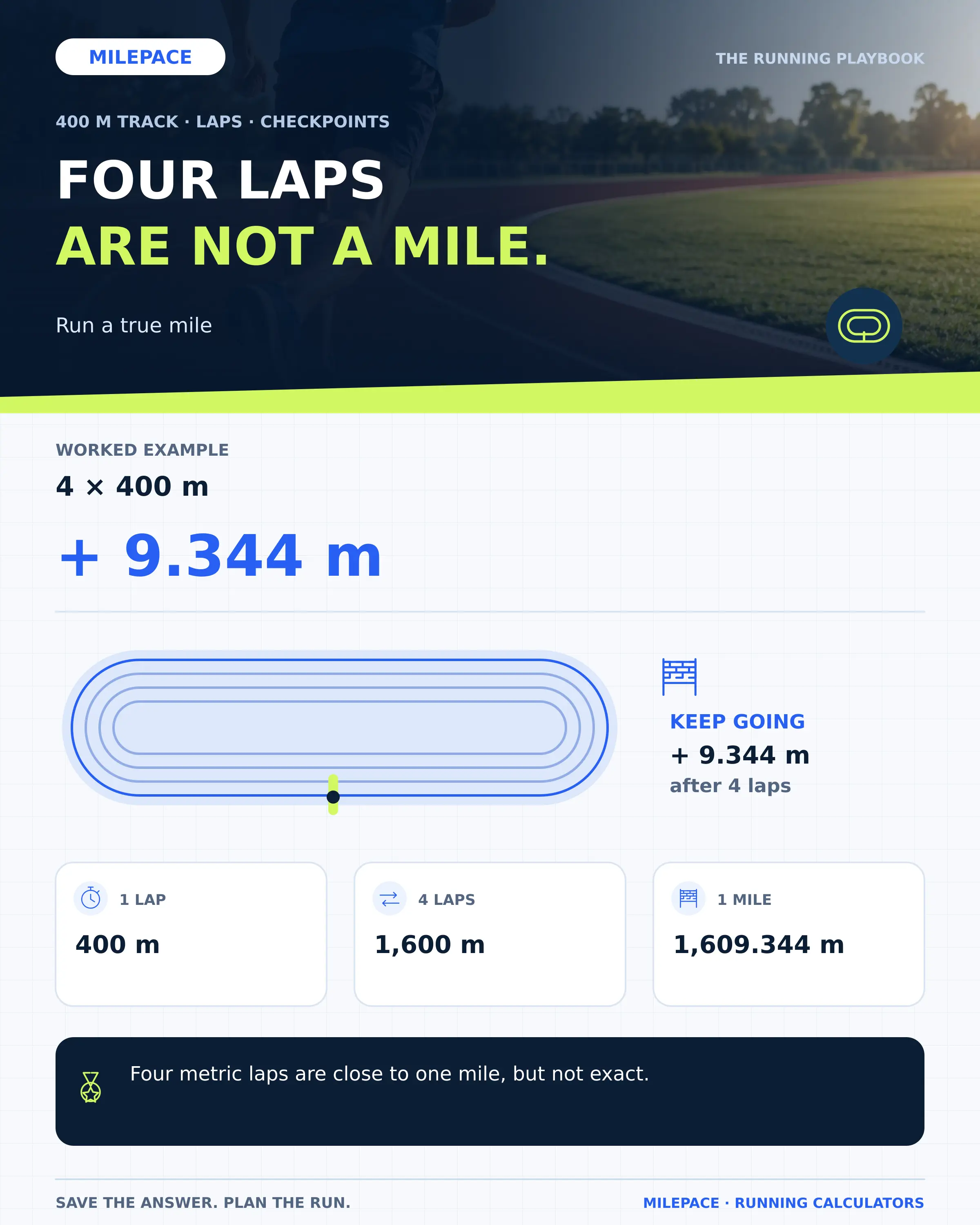
Four 400-meter laps total 1,600 meters. A mile is 1,609.344 meters, so the difference is 9.344 meters. The USATF New England mile lap sheet also distinguishes the mile distance on a 400-meter track.
Where that extra distance appears in a real event depends on the marked start and finish. You should use the correct event markings rather than adding a guessed distance after an arbitrary finish line. The calculator describes distance from your chosen starting point; it can’t identify painted lines at your facility.
The measured lane matters too. If you run a different path from the one used for the lap measurement, your actual distance can differ. Enter a measured custom lap if that is what your session uses. This tool doesn’t calculate individual lane geometry.
Also, a 1,500-meter race and a mile are separate distances. Converting the time at the same pace is straightforward, but estimating how your race performance changes between them is a different question. Keep the lap plan and performance prediction separate when interpreting the result.
Use the split plan at the track
You can compare the cumulative stopwatch column with a watch that runs continuously, which gives you a straightforward check at each distance marker. If your 400-meter target is two minutes, the 800-meter reading is four minutes and the 1,200-meter reading is six minutes. However, if you’re pressing the lap button at each checkpoint, the segment column is the one that matches those individual readings. Printing or copying the plan beforehand lets you keep that comparison handy without working out the next checkpoint while you’re running.
The interval chart shows uninterrupted running time at each pace. Recovery between repeats is separate. Six 400-meter repeats with rest aren’t equivalent to a continuous 2,400-meter run at the same clock time.
Use the Training Pace Calculator if you need a pace reference from a recent race result. Then choose the repetition distance here to see its stopwatch equivalent. That sequence keeps the training-intensity decision separate from the arithmetic of a lap, especially when an interval would be unusually long at your chosen pace.
Analyze actual completed splits
Switching to the Actual Split Analyzer mode turns this tool from a forward planner into an evaluation system for completed running sessions. You can enter recorded lap times from your track workout or cumulative stopwatch checkpoints from a road race.
When analyzing segments of unequal distance, simple arithmetic averages produce misleading numbers. For example, if you run one mile in 8:00 (8:00/mi) and then run two miles in 20:00 (10:00/mi), averaging 8:00 and 10:00 would give 9:00 per mile. But that unweighted average ignores the fact that you spent twice as much distance at the slower pace. Your true overall performance covers three miles in 28:00, which yields a distance-weighted average pace of 9:20 per mile. Our analyzer calculates this distance-weighted average pace strictly from total duration divided by total distance.
Distance-weighted average pace = total elapsed seconds ÷ total meters × pace unit distance
The analyzer also distinguishes individual lap times from cumulative stopwatch checkpoints. Cumulative times are never added together as segment durations; each segment duration is derived by subtracting the preceding cumulative checkpoint. If a cumulative time does not exceed the previous checkpoint, it is rejected immediately.
To evaluate pacing discipline, the tool compares the first half against the second half of your run. If your split markers do not land exactly on the 50% distance boundary (for example, if you record unequal laps or odd distances), the calculator clearly notes that the halfway split was not directly measured and provides a labeled constant-pace interpolation estimate rather than fabricating false precision.
Frequently Asked Questions
Why is there a partial lap at the end?
Your target distance may not divide evenly by the lap or checkpoint distance. The final row covers the remaining meters so the total matches your selected run.
Can I enter a 300-meter loop?
Yes. Choose a custom measured lap and enter 300 meters. The plan then uses that length instead of assuming a standard track.
Why don’t rounded splits add up exactly?
The calculator adds unrounded times, then formats the display. Adding already rounded segment values yourself can introduce a small difference at the finish.
Does the drawing locate me on the track?
No. It’s a schematic of a lap and its equal-distance checkpoints. It doesn’t use GPS or show the exact position of event markings at your track.
Why does the analyzer pace differ from averaging my lap paces?
If your laps or segments have different distances, an unweighted average treats a short segment with the same importance as a longer one. The analyzer weights each segment by its exact distance (total elapsed time divided by total distance), giving you the true average pace of the entire run.
What does ‘not directly measured’ mean in the half comparison?
When your recorded checkpoints do not include a marker placed exactly at the halfway distance, the calculator cannot know your exact split at that moment. Rather than inventing a measurement, it calculates a constant-pace estimate for that containing segment and labels the result as an interpolation.