
Pace Band & Race Card Generator
Turn a goal finish time or mile pace into printable checkpoints. Choose a mile, 1.5 miles, 5K, 10K, half marathon, marathon or custom distance, then print a wristband or pocket card.
Plan summary
- Distance
- 42.195 km
- Target finish
- 4:00:00
- Average mile pace
- 9:09 / mi
- Average km pace
- 5:41 / km
- Pacing strategy
- Even pace
- Interval split
- 1 mile
Physical calibration: print at 100% scale (disable 'Fit to page'). Verify size against the ruler markings before cutting and wrapping with clear tape.
MILEPACE PACE BAND
| Split | Pace | Clock |
|---|
RACE DAY SPLIT CARD
Complete split checkpoints & timing stops
Review split durations and cumulative elapsed stopwatch times at every checkpoint.
| # | Checkpoint | Segment Dist | Segment Time | Elapsed Time | Segment Pace |
|---|
Build a pace band for your goal time
Select your distance and enter a finish time or pace. Choose checkpoints every mile, kilometer, 400 meters or a custom interval. The final partial segment is included, so the finish checkpoint matches the total goal time. A mile is exactly 1,609.344 meters; 1.5 miles is 2,414.016 meters, or six full 400-meter laps plus 14.016 meters.
Read the pacing strategies
Even pacing uses the same pace throughout. A negative split assigns less time to the second half; a positive split assigns more. Here the percentage describes the second-half time relative to the first-half time. Each half uses a constant pace, with the change at halfway. A segment crossing halfway combines both paces. These are mathematical plans, not recommendations that a particular strategy or finish time suits you.
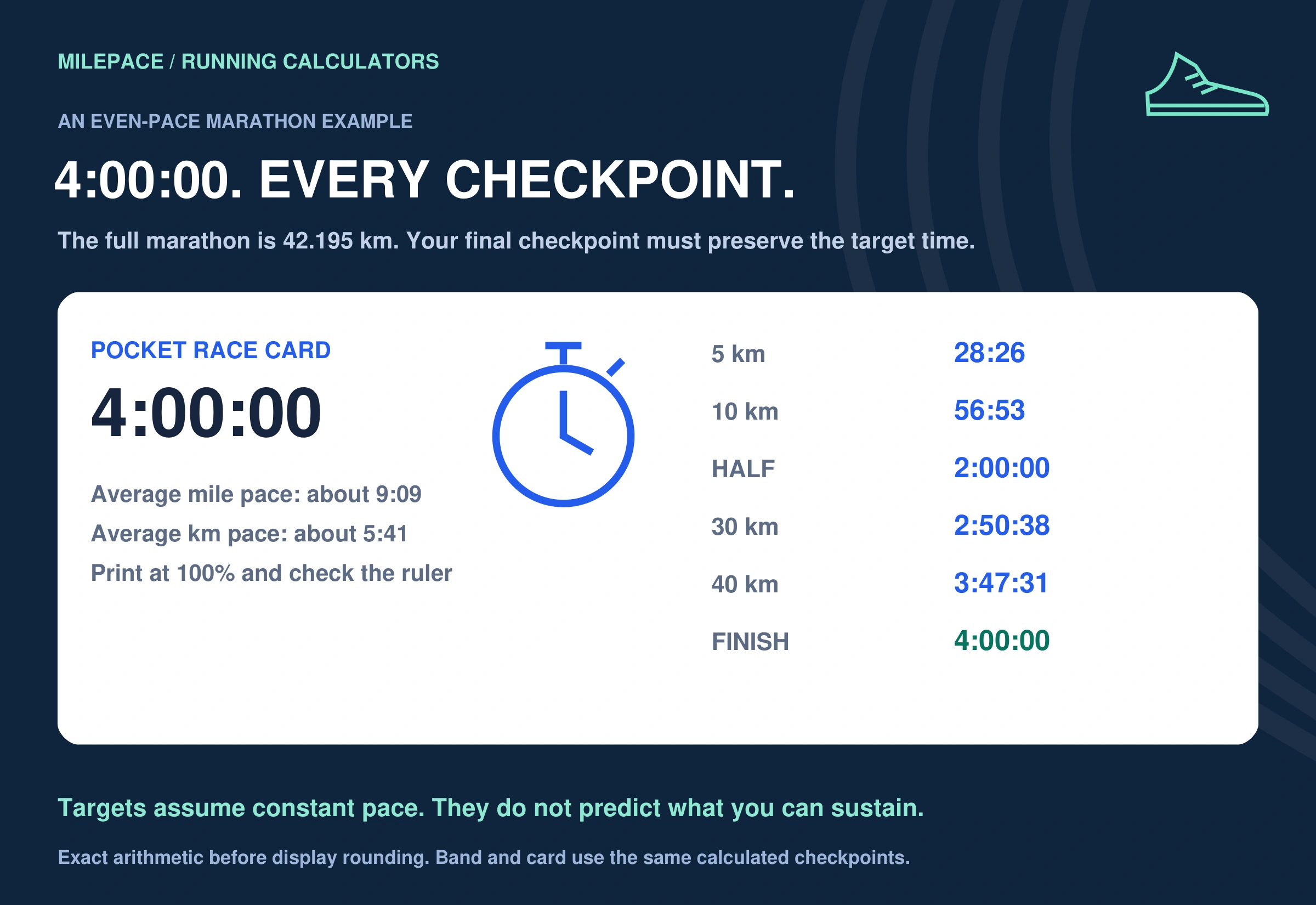
For example, a 4:00:00 marathon has an average pace of about 9:09 per mile or 5:41 per kilometer. An even plan reaches halfway at 2:00:00. With a 3% negative split, the halves take about 2:01:50 and 1:58:10. Check the calculated table for each checkpoint rather than rounding a mile pace and multiplying it repeatedly.
Print at actual size
Select a wristband or pocket card, then use the print button. Choose A4 or Letter paper, set scale to 100% or Actual Size and disable Fit to Page. Check the calibration line against a ruler. Browser and printer margins differ, so inspect print preview before cutting. Dense tables may need several pages; use a larger checkpoint interval if necessary.
Cut along the outline and protect the paper with clear tape if useful. The band is a time reference, not a guarantee that you can hold the selected pace. Weather, terrain, stops and fatigue can change the actual result.
Use course markers with context
GPS distance can differ from official course distance because of measurement error and the route you actually run. Compare cumulative elapsed time with the event’s marked checkpoints where available. A pace band cannot correct inaccurate markers or predict conditions along the course.
Save and share your plan
My Mile saves the inputs and checkpoints in this browser as a plan. It does not add planned distance to completed activity totals. Export a JSON backup before changing browser or domain. The share link restores calculation settings without including your optional personal label. You can also download the checkpoint table as CSV.
Use the Pace Converter for unit conversion, the Track Pace Calculator for laps and actual split analysis, or the 1.5-mile calculator for a test-specific goal. Follow your existing training plan when choosing a goal.