

Mile Pace Calculator
The mile pace calculator divides your running time by distance to find your average minutes per mile. You can also calculate finish time or distance when you know the other two values, then check your speed in miles per hour and plan splits. Whether you’re checking a one-mile effort or a longer run, the examples below show which numbers you need and how to read your result.
Enter your distance and time.
We'll take care of the numbers.
See Where Your Speed Sits

Enter your run details to place your pace on the reference scale.
Your Mile-By-Mile Split Plan.
Your Pacing Track
Even splitsOne loop represents your entire run, not a measured 400-meter track or a real route. Segment lengths represent distance.
Seconds Per Mile Faster Or Slower
Enter a valid split interval to see your track. Your main pace result stays available.
Same Pace. Different Distance.
Finish times if you hold this exact pace.
These are arithmetic projections, not race predictions. Holding the same pace over a longer distance may not be realistic.
| Split | Distance | Split Time | Total Distance | Running Time | Pace / Mile | Vs. Average / Mile | Elapsed Time |
|---|
Times are calculated before rounding. Rounded segment times may differ slightly from the rounded total.
Pace ↔ Speed Explorer
This independent comparison does not change your run.
How the mile pace calculator finds your pace
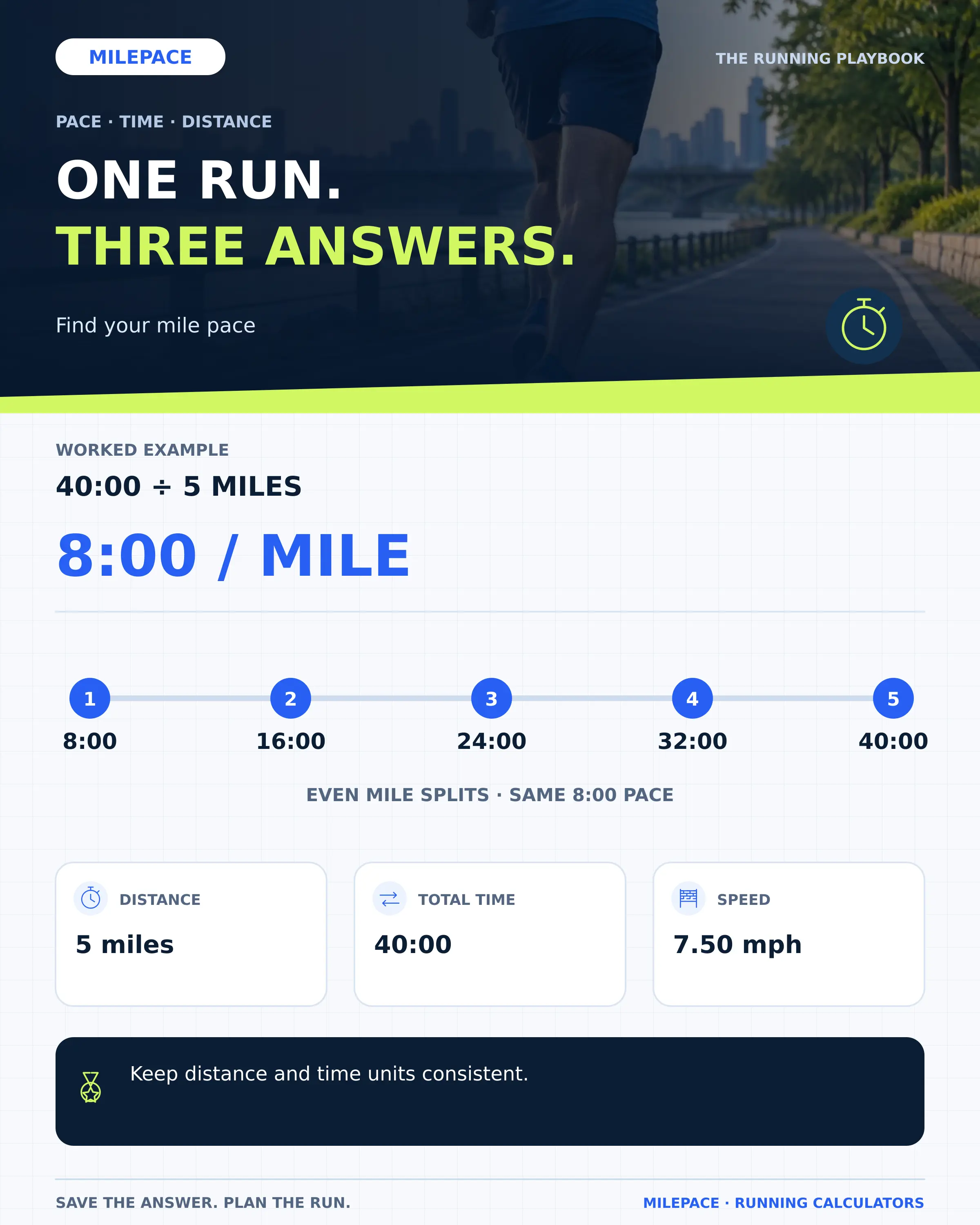
Your average pace per mile is your total time divided by the number of miles you covered. For instance, if you run five miles in 40 minutes, each mile takes eight minutes on average, so your result is 8:00 per mile. A smaller time per mile means you’re covering the same distance faster.
Pace = total time ÷ distance
Finish time = pace × distance
Distance = total time ÷ pace
For a calculation by hand, changing the total time to seconds makes the division easier: four miles in 35 minutes is 2,100 seconds divided by four, giving 525 seconds per mile. That’s 8 minutes 45 seconds, written as 8:45/mi.
The units follow your distance: time divided by miles gives minutes per mile, while time divided by kilometers gives minutes per kilometer. A result in a “per mile” field is a duration, such as 8:45, and labels like min/mi, mile pace and minutes per mile describe that same measure.
How to use pace, time and distance modes
You need two values to calculate the third: distance and time for pace, distance and pace for finish time, or time and pace for distance. The tabs let you choose the answer you’re looking for, so you can use the same calculator for a completed run or a planned workout.

| You need | Choose | Enter | Example result |
|---|---|---|---|
| Average mile pace | Pace | 5 miles and 40:00 | 8:00 per mile |
| Running time | Time | 4 miles and 9:30 per mile | 38:00 |
| Running distance | Distance | 30:00 and 10:00 per mile | 3 miles |
- Choose Pace, Time or Distance for the value you want to find.
- Enter the two known values, checking the distance and pace units beside them.
- Read the result, then open Advanced Options if you need different splits or display precision.
The race-distance menu includes a 2 Miles preset, and custom entries accept distances such as 1.8 or 3.2 miles without rounding them to a whole mile. For a one-mile run, total time and mile pace are the same: one mile in 8:00 gives an 8:00 mile pace.
The clock fields accept hours, minutes and seconds separately, so a 40-minute run belongs in 0 hours, 40 minutes and 0 seconds. Also, blank clock fields count as zero once a time is entered, but the calculation still needs a positive total time and distance.
Worked running pace examples
Two miles in 19:44 gives a 9:52 mile pace, and four miles in 35 minutes gives 8:45 per mile. The table includes both short runs and longer distances, with average pace rounded to the nearest second so you can check a complete calculation against your own result.
Times shown as hours:minutes:seconds include the hours field.
| Distance | Total time | Pace per mile |
|---|---|---|
| 1 mile | 8:00 | 8:00 |
| 1.5 miles | 12:00 | 8:00 |
| 2 miles | 19:44 | 9:52 |
| 4 miles | 35:00 | 8:45 |
| 4 miles | 1:00:00 | 15:00 |
| 6 miles | 28:00 | 4:40 |
| 18 miles | 4:30:00 | 15:00 |
| 20 miles | 3:00:00 | 9:00 |
| 1.5 kilometers | 8:00 | 8:35 |
For the two-mile example, 19 minutes 44 seconds is 1,184 seconds, and dividing by two gives 592 seconds per mile. Also, 4.5 hours means four hours and 30 minutes, so the 18-mile example uses 270 minutes divided by 18.
A 1.5 km run in eight minutes gives 5:20 per kilometer, or about 8:35 per mile, while a 1.5-mile run covers a longer distance. For a mile-and-a-half test, the 1.5-mile calculator and pace chart explains goal times and track checkpoints.
How do you calculate average pace over unequal distances?
You add the segment times and distances first, then divide total time by total distance. For instance, if the first mile takes 8:00 and the next two miles take 18:00, the combined distance is three miles and that’s 26:00 of running time.
Your average pace is 26 ÷ 3 minutes per mile, or 8:40.
| Segment | Distance | Time | Segment pace |
|---|---|---|---|
| First segment | 1 mile | 8:00 | 8:00 per mile |
| Second segment | 2 miles | 18:00 | 9:00 per mile |
| Whole run | 3 miles | 26:00 | 8:40 per mile |
Simply averaging 8:00 and 9:00 would give 8:30, which leaves out the extra mile you ran at the slower pace. You can average the pace figures directly when the distances are equal, such as one mile at 8:00 and another at 9:00. In the calculator, enter the combined three miles and 26 minutes to check the unequal-distance example.
What pace is 13.1 miles in two hours?
Exactly 13.1 miles in two hours gives about 9:10 per mile when rounded to the nearest second. The Half preset gives about 9:09 because it uses the full half-marathon distance of 21.0975 km, approximately 13.1094 miles. Both calculations use the same two-hour time, but the preset covers slightly more distance.
| Distance entered | Total time | Rounded mile pace |
|---|---|---|
| 13.1 miles custom | 2:00:00 | 9:10 |
| Half preset: 21.0975 km | 2:00:00 | 9:09 |
The World Athletics course-measurement handbook lists the half marathon as 21.0975 km and the marathon as 42.195 km. So, the preset fits a race over the standard distance, while a custom mile entry fits the distance you actually measured.
Time mode also works as a marathon time calculator in miles: at 9:00 per mile, a custom 26.2 miles takes 3:55:48, while the exact Marathon preset takes about 3:55:58. Also, these finish times assume you’re holding that pace throughout.
How many minutes or miles? Supply the missing pace
A distance needs a pace or speed before you can turn it into minutes. For example, 3.2 miles takes 32:00 at 10:00 per mile, or 25:36 at 8:00 per mile. Time mode works as a miles-to-minutes calculator once you enter a distance and the pace you expect to hold.
| Distance | At 8:00 per mile | At 10:00 per mile |
|---|---|---|
| 1.8 miles | 14:24 | 18:00 |
| 2.8 miles | 22:24 | 28:00 |
| 3.2 miles | 25:36 | 32:00 |
| 3.4 miles | 27:12 | 34:00 |
| 3.6 miles | 28:48 | 36:00 |
| 4.4 miles | 35:12 | 44:00 |
| 18 miles | 2:24:00 | 3:00:00 |
So, if you’re asking how many minutes 4.4 miles takes, you might plan for 44 minutes at a ten-minute mile. The pace supplies the assumption for that finish time, and the same applies to the shorter decimal-mile runs in the table.
To find how many miles you can cover in 26 or 30 minutes, choose Distance mode and add your pace. For 26 minutes at 10:00 per mile, dividing 26 by 10 gives 2.6 miles, while an 8:00 pace gives 3.25 miles in that same time.
| Running time | At 8:00 per mile | At 10:00 per mile |
|---|---|---|
| 26 minutes | 3.25 miles | 2.6 miles |
| 30 minutes | 3.75 miles | 3 miles |
How many minutes does one mile take?
One mile takes as many minutes as your minutes-per-mile pace: at 10:00/mi it takes ten minutes, and at 15:00/mi it takes fifteen. You need a pace or speed to choose between them, so there isn’t a fixed time conversion for the distance alone.
You can use this as a walking pace calculator too. For instance, walking at 15:00 per mile gives two miles in 30 minutes; at 20:00 per mile, the same half hour gives 1.5 miles. Choose Distance and enter your own time and walking pace to calculate your distance.
Running speed in miles per hour and your split plan
Your running speed in miles per hour is miles divided by hours, or 60 divided by your pace in decimal minutes per mile. For five miles in 40 minutes, the speed is 7.5 mph because 40 minutes is two-thirds of an hour, with MPH shown beside the pace result. The other results include km/h and pace per kilometer.
| Mile pace | Miles per hour | Kilometer pace, rounded |
|---|---|---|
| 8:00 | 7.50 mph | 4:58 |
| 9:00 | 6.67 mph | 5:36 |
| 10:00 | 6.00 mph | 6:13 |
You can use the Pace Converter when you already know your speed and want the equivalent running pace. Also, it converts miles per minute, which lets you move between a clock pace and a speed without supplying a run distance.
You can use this as a mile pacer for planning your checkpoints, with the split table showing the time to aim for at each marker. An 8:00 pace gives cumulative mile checkpoints of 8:00, 16:00 and 24:00. In Advanced Options, you can change the interval to kilometers, 400 meters or a custom distance.
A full mile is exactly 1,609.344 meters under the international-mile conversion listed by NIST. Four 400-meter laps cover 1,600 meters, leaving another 9.344 meters for a mile. The Track Pace Calculator helps you plan measured laps and the remaining distance.
Advanced Options also lets you compare even, negative and positive splits. A 3% negative split makes the second equal-distance half take 3% less time than the first; over 40 minutes, that’s about 20:18 followed by 19:42, with the total still fixed at 40 minutes.
The “Same Pace. Different Distance.” results show finish times if you maintain your current average pace. But maintaining that pace for a longer race also depends on preparation, so the arithmetic alone cannot tell you whether a particular race goal is achievable.
40 miles in two hours: how many miles in one hour?
At a constant rate, the answer is 20 miles in one hour: divide 40 miles by two hours. That is an average speed of 20 mph, or a pace of 3:00 per mile, because 120 minutes divided by 40 miles gives three minutes.
To check this word problem above, choose Pace, enter 40 miles and a time of two hours. If the speed varied during the two hours, the total still gives a 20 mph average, but it doesn’t tell you the distance covered in the first hour specifically.
Keep your My Mile record and plan the next run
Open My Mile to save and review your running records, plans and calculator results. You can add a completed run, walk or run-walk activity manually, or use Save to My Mile beside a valid calculator result. The saved entry keeps the date and notes with the inputs, units and result.
When using it as a mile time tracker, keep completed activities separate from targets and estimates. In Pace mode, you can mark this calculation as a completed activity after confirming that the entered distance and time describe something you actually did. Time and Distance modes save plans, while other tools keep the appropriate plan, estimate or conversion label.
Your records stay in this browser for this site. My Mile includes JSON backups for restoring or moving full records and a CSV summary for spreadsheets. Download a backup before clearing site data, changing devices or moving to another domain.
Running pace chart for common race goals
A 30-minute 5K requires about 9:39 per mile, while a four-hour marathon requires about 9:09 per mile. Select the exact race preset above and enter your target finish time to calculate your own mile pace and split times.
| Race distance | Finish goal | Pace per mile | Pace per km |
|---|---|---|---|
| 5K | 30:00 | 9:39 | 6:00 |
| 10K | 1:00:00 | 9:39 | 6:00 |
| Half marathon | 2:00:00 | 9:09 | 5:41 |
| Marathon | 4:00:00 | 9:09 | 5:41 |
These are constant-pace calculations for the standard distances, not predictions of what you can currently run. To compare a recent result with another race distance, use the Race Time Predictor and keep its endurance assumptions with the estimate.
Running pace calculator for miles, kilometers and finish time
Use this running pace calculator in miles or kilometers to calculate your average pace, planned running time or covered distance. As a mile time calculator, it works from your selected distance and target pace. To find your pace after a run, enter the measured distance and completed time instead.
For a quick paper reference, use the running pace conversion chart. The 5K, 10K, half-marathon and marathon pace charts show selected finish goals and cumulative checkpoints.
Choose a named prediction method when you need more than constant-speed arithmetic: the Magic Mile calculator uses a measured mile trial, while the marathon predictor uses the evidence its selected method requests.
Frequently Asked Questions
Should I use moving time or elapsed time?
Use elapsed time if you want stops included, or moving time to describe the time you were active. Strava’s explanation of moving and elapsed time shows why those figures can differ. Whichever you choose, use the same timing method when comparing your runs.
Is 8.30 minutes the same as an 8:30 mile?
No. An 8:30 mile is eight minutes and 30 seconds, or 8.5 decimal minutes. If your source says 8.30 decimal minutes, the decimal part is 0.30 × 60 = 18 seconds, giving 8:18. In the calculator’s separate pace fields, enter minutes and seconds as labeled.
Does the oval track my GPS route?
The oval is a drawing of the distance and splits you’ve entered, and one loop represents your whole run. It doesn’t record your location or measure a route. You supply the distance from your measured course, watch or other record.
Can I calculate walking pace too?
Yes, the same time-and-distance calculation works for walking. For instance, two miles in 40 minutes gives 20:00 per mile and 3 mph. Your activity label doesn’t change the arithmetic, so you can enter your walking distance and time in Pace mode.
How do I calculate my mile pace?
To calculate run pace, divide completed time by measured distance. Three miles in 31:39 gives 10:33 per mile. Keep the time in seconds while dividing, then format the result as minutes:seconds.
How fast was I running?
Enter your distance and completed time in Pace mode. The mile calculator shows average mile pace, kilometer pace and running speed in MPH; these describe the whole entered distance rather than your fastest moment.
Can I use this as a mile time calculator?
Yes. Choose Time mode, enter one full mile and your chosen pace. For another distance, use its exact preset or enter the measured length. The result assumes you hold that pace throughout.
How do I convert minutes to miles?
Time alone needs a pace before it becomes distance. At 10:00 per mile, thirty minutes covers three miles. Choose Distance mode and enter the duration and pace you intend to maintain.
Can the mile split calculator plan a longer race?
Yes. Choose the full race distance, then use Advanced Options to select mile, kilometer, 400-meter or custom checkpoint intervals. The split table follows your selected pacing strategy; it does not record live movement.