

Run-Walk Pace Calculator
The run-walk pace calculator combines separate running and walking paces with the time you spend at each. Enter a distance or duration goal to see your average pace, interval schedule and projected finish. You can also solve for a missing pace or interval when you’re trying to match a target.
Planned Finish Time
Your Repeating Cycle
Bar lengths show time in one complete cycle, not distance. Each cycle starts with running.
Total Running
—Total Walking
—Your Run-Walk Pace Chart And Interval Plan
| Interval | Action | Time | Distance | Elapsed Time | Total Distance |
|---|
Partial means the final interval ends before its usual duration. Times round to the nearest second; distances round to three decimals. Calculations use unrounded values, so rounded rows may not add up exactly.
Finish Times At This Run-Walk Pattern
These projections repeat your exact interval order at each distance. Each finish stops at the target, even in the middle of an interval.
| Distance | Finish Time | Average Pace | Final Interval |
|---|
How the run-walk pace calculator combines intervals
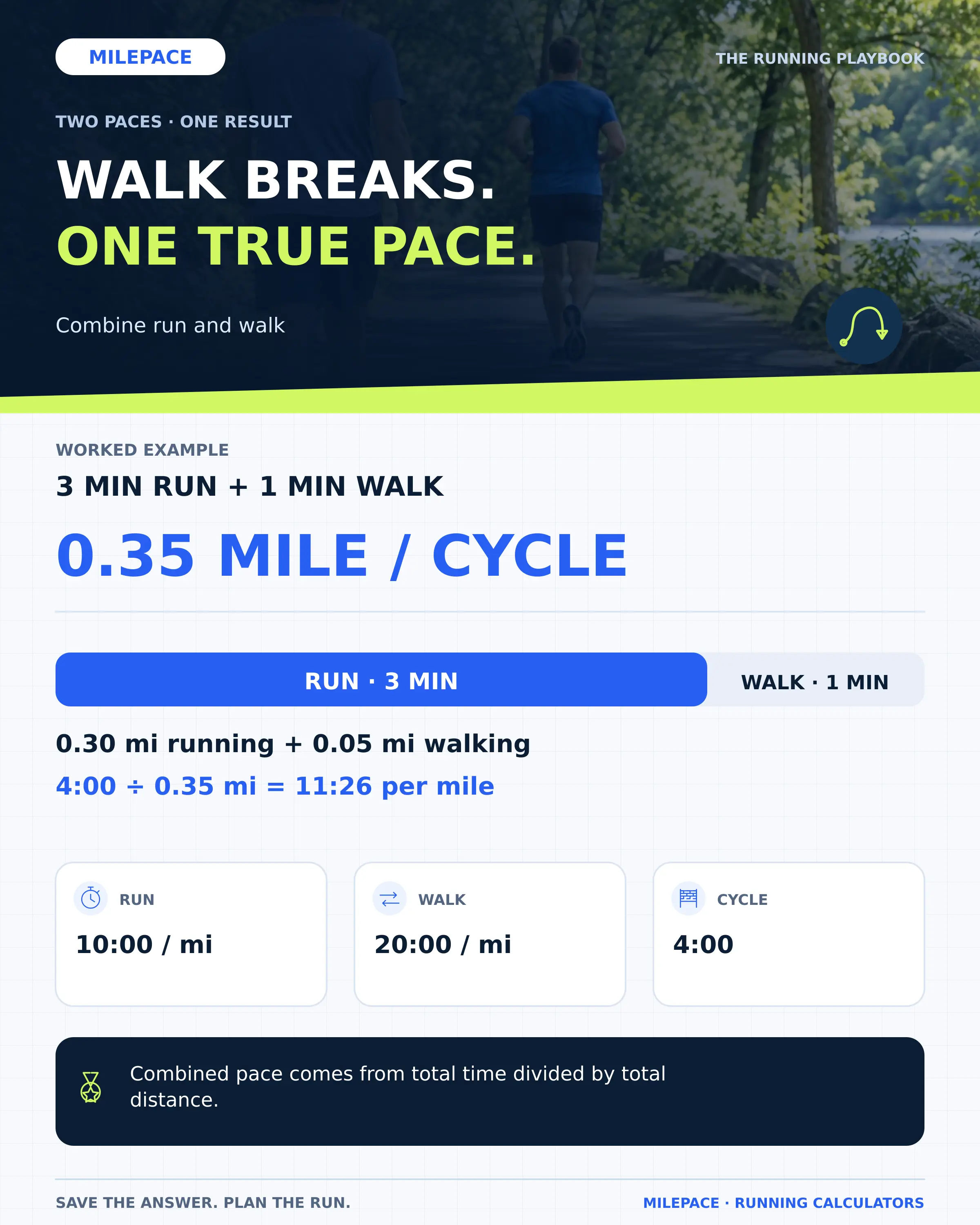
Your combined pace is total time divided by total distance, so the calculator first finds the distance covered during each running and walking part rather than averaging their pace numbers. Suppose you run for three minutes at 10:00 per mile and walk for one minute at 20:00 per mile. You’ll cover 0.3 mile running and another 0.05 mile walking, giving 0.35 mile over the full four-minute cycle. Dividing those four minutes by 0.35 mile gives a combined pace of about 11:26 per mile.
Cycle distance = run time ÷ run pace + walk time ÷ walk pace
Cycle pace = total cycle time ÷ cycle distance
All the values must use matching time and distance units. If you work in seconds per mile, the interval durations must also be in seconds. The calculator handles those conversions after you enter the clock values.
A simple average of the two pace numbers would give 15:00 per mile in this example, which ignores how much farther you travel during the faster part. Even a time-weighted average of paces isn’t the correct calculation; distances need to be added first.
Enter run and walk settings
You’ll need a running pace, a walking pace and the time spent at each, with the same pace unit used for both activities. A run interval of 3:00 means three minutes of running per cycle, rather than three miles. Next, you can choose a distance goal to see projected finish time, or a duration goal to see how far the pattern carries you before the clock runs out. The starting activity matters too, especially when your session ends partway through a run or walk instead of completing another full cycle.
The target-solving controls answer a more specific question. You can keep the walking pace and both intervals fixed, then ask what running pace would produce your target average. Alternatively, solve for an interval length while keeping both paces fixed.
For an interval-length calculation, the target needs to fit between the entered running and walking paces. If the numbers can’t produce a positive interval, the tool asks you to change them. That message describes the arithmetic of your chosen settings, not a judgment about your fitness.
Use paces you’ve actually been able to maintain during comparable sessions when possible. A mathematically valid plan can still depend on an unrealistic input.
Worked run-walk pace examples
Changing the interval ratio changes the distance you cover, even when both paces stay fixed. Here the running pace is 10:00 per mile and the walking pace is 20:00 per mile throughout.
| Run / walk time | Distance per cycle | Average pace |
|---|---|---|
| 1:00 / 1:00 | 0.15 mile | 13:20/mile |
| 2:00 / 1:00 | 0.25 mile | 12:00/mile |
| 3:00 / 1:00 | 0.35 mile | 11:26/mile |
| 4:00 / 1:00 | 0.45 mile | 11:07/mile |
These are examples of the calculation, rather than recommended ratios. Your entered walking pace has an effect too. Slowing the walking segment while leaving everything else unchanged reduces the total distance per cycle.
Also, 30 seconds running and 30 seconds walking has the same complete-cycle average as one minute running and one minute walking at those same two paces. The total number of changes between activities differs. For a specific finish line, the final partial interval can create a small difference in the whole-run average.
Finish a race with a partial interval
The calculator stops as soon as you reach the selected distance or duration, even when that point falls inside a planned interval. For instance, three minutes running at 10:00 per mile followed by one minute walking at 20:00 per mile covers 0.35 mile per cycle. Two cycles therefore give you 0.7 mile in eight minutes, leaving another 0.3 mile to complete a one-mile goal. If you start with running, that final part takes three minutes and you finish in 11:00, with no extra walking break added after the finish.

That differs from multiplying the complete-cycle average, about 11:26, by one mile. The run ends after a running segment instead of including another walking break. Over a long distance the effect of one partial cycle is usually smaller, but it still belongs in the arithmetic.
The interval table shows each activity, its duration and the cumulative distance. Read the final row when you need the exact planned finish. For a steady run without separate activities, the Mile Pace Calculator is the simpler choice.
Use the plan and understand its limits
Use the result to compare interval patterns and understand their timing. The calculator holds each running and walking pace constant, so it doesn’t model fatigue, hills, aid-station queues or the time needed to speed up and slow down.
Planned run/walk breaks are a recognized running approach; Jeff Galloway explains the approach on his own site. This tool calculates the pattern you enter. It doesn’t choose a personalized training ratio or establish that a particular race plan is suitable for you.
You can copy or print the schedule and compare it with a session. If the actual paces differ, update those inputs before relying on the projected finish. That is more useful than keeping an attractive finish time based on numbers you couldn’t maintain.
If you need a basic speed conversion, the Pace Converter changes your running and walking paces into mph or km/h. Keep the two paces separate when entering them here, because one overall average doesn’t describe how your intervals are divided.
Frequently Asked Questions
Does starting with walking change the finish?
It can. Complete cycles have the same total time and distance, but a short session or final partial cycle depends on which activity comes first.
Are water stops included automatically?
No. The schedule contains the two moving paces you’ve entered. A stationary stop takes time without adding distance, so account for it separately when planning elapsed time.
Can I use seconds for short breaks?
Yes. Enter a duration such as 0:30 for a 30-second break. Keep the minutes:seconds format, including the zero before the colon.
Will the calculator tell me whether I can finish a marathon?
No. It projects the entered paces and intervals to a distance. It doesn’t assess endurance, medical readiness or whether the pattern will remain sustainable.