

Race Time Predictor
The race time predictor estimates a finish time at another distance from a recent race result. It uses a Riegel endurance formula, with an adjustable factor and an option to compare two races. Enter a genuine race effort, then use the estimate as a starting point for planning rather than a guaranteed performance.
Predicted 10K Time
Same Pace Or Race Prediction?
Equivalent Race Times And Paces
This running pace equivalent chart applies your selected method to each distance. Choose a race to make it your main result.
| Race | Finish Time | Pace / Mile | Pace / km | Compare |
|---|
Times and paces round independently to the nearest second; calculations retain full precision. “Recent race” identifies your input. “Selected” identifies your target. Marathon estimates need particular caution.
How Much Does The Assumption Matter?
These three scenarios change only the endurance factor. They are an illustration of model sensitivity, not a confidence interval or a best/worst guarantee.
How the race time predictor estimates another distance
The race time predictor multiplies your recorded time by a distance ratio raised to an endurance factor. That factor allows the average pace to become slower as the target race gets longer, rather than assuming you can hold the same speed indefinitely.
Predicted time = recorded time × (target distance ÷ recorded distance)factor
This version starts with a factor of 1.06. The result changes if you adjust it, so keep the factor alongside the predicted time when comparing outputs from different calculators. A tool using another default can give a different answer from the same race.
The displayed constant-pace comparison uses a factor of one in effect: it extends the same speed to the target distance. Seeing the two values together makes the model’s assumed slowdown easier to understand.
The calculation works in either direction within the supported distances. You can estimate a 10K from a 5K, or look at a shorter-distance equivalent from a longer race. Neither direction measures your actual fitness at the new distance. The recent result, distance and selected factor supply all the information used by this model.
Choose comparable race results
Your most useful starting point is a recent race over a known distance that reflects your current fitness, rather than an easy training run with effort left in reserve. Enter its official distance and finish time using minutes:seconds or hours:minutes:seconds, such as 25:00 or 1:50:00. That keeps the timing clear when you compare it with another result, particularly if one source has written times as decimal minutes. The formula treats the recorded performance as a race effort, so the type of run you enter affects what its prediction means.

A hilly race in strong wind and a flat race in mild conditions aren’t directly interchangeable. This predictor doesn’t adjust those conditions automatically. If you use both to fit an endurance factor, their differences can influence the result as much as the change in race distance.
For instance, an older 5K personal best and a recent half marathon may represent two different stages of fitness. The equation can still divide their times, but the fitted number won’t necessarily describe today’s endurance.
If your question is simply what a known pace produces over a chosen distance, use the Mile Pace Calculator. That tool answers a constant-speed planning question without adding an endurance assumption.
Understand the endurance factor
A larger endurance factor produces more slowdown when you’re estimating a longer race from a shorter one, with the size of the change depending on the distance ratio as well. It is part of an exponent, rather than a percentage you can simply add to the finish time. If you have two comparable races over different distances, you can fit that factor by dividing the logarithm of their time ratio by the logarithm of their distance ratio. Both times and both distances need consistent units, which the calculator handles after you’ve selected them.
Fitted factor = ln(time₂ ÷ time₁) ÷ ln(distance₂ ÷ distance₁)
The tool supports factors from 1.00 to 1.30. That is an implementation limit for these calculations, not a published ranking of runners. If your two results fall outside it, check the distances, dates, effort levels and conditions before relying on the fit.
You can compare the fitted result with the standard model instead of replacing it without inspection. Two races supply only two observations. They can’t establish how your performance will respond to a different course, another training cycle or a much longer distance. A close mathematical fit to past results still leaves those questions open.
Worked 5K to 10K prediction
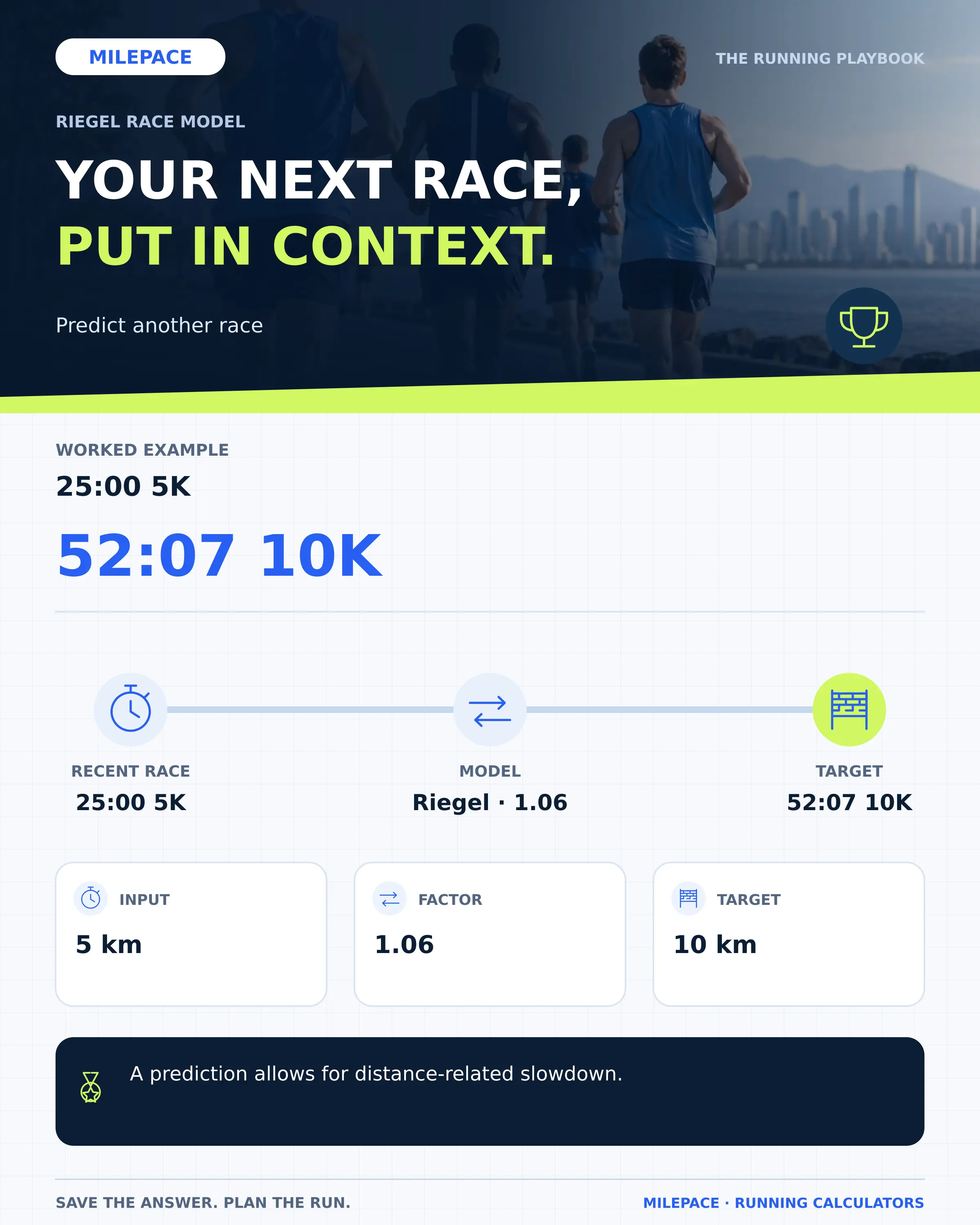
A 25-minute 5K gives a 10K prediction of about 52:07 with the default factor of 1.06. The target distance is twice the recorded distance, so the calculation is 25 minutes × 21.06.
| Assumption | 10K time |
|---|---|
| Constant pace | 50:00 |
| Factor 1.04 | 51:24 |
| Factor 1.06 | 52:07 |
| Factor 1.08 | 52:51 |
The table is a sensitivity example, not a set of probabilities. It shows how one assumption changes the estimate. You can’t read the fastest and slowest entries as a personal confidence interval.
For the default prediction, average target pace is about 5:13/km. If you decide that time fits your preparation, you can use the main pace calculator to generate individual checkpoints. Keep the full predicted time for that step; multiplying an already rounded pace across the race can shift the final seconds.
Also, the factor that seems suitable for a 5K-to-10K comparison may be less informative for a marathon. The longer projection asks more of the model.
Use a prediction to plan your next race
You can compare the estimate with your recent training and the target course before choosing a goal, remembering that this model has no input for long runs, weekly distance or fueling. That gap matters particularly when you’re extrapolating to a marathon. In their study of recreational runners, Vickers and Vertosick found that the tested Riegel approach was too optimistic for many marathon results and developed mileage-based alternatives. The finding gives you a reason to inspect a longer-distance estimate alongside your preparation instead of treating the displayed time as a race plan by itself.
The Marathon Time Predictor implements those alternatives with typical weekly mileage and one or two races. You can compare the methods without assuming that either one guarantees your finish.
If you need workout pace references rather than race equivalents, open the Training Pace Calculator. A predicted race pace and an easy-run pace serve different purposes. Choosing the right output first helps you avoid turning every estimate into an intensity you feel obliged to maintain in training.
Frequently Asked Questions
Why can two race calculators disagree?
They may use different formulas, endurance factors, inputs or rounding. Compare those assumptions before deciding that one number is an error.
Can I use a race from several years ago?
You can calculate an equivalent from it, but it describes that recorded performance. It may be a poor starting point for a prediction about your current fitness.
Does the estimate include time lost at stops?
No separate stop allowance is added. If you’re planning an elapsed finish time with aid-station or other stops, account for them separately.
Does fitting two races prove the model is accurate?
No. The fit describes the relationship between those results. A future race introduces conditions and preparation that the equation doesn’t measure.