
Mile Training Plan: First Mile and Faster Mile Schedules

A mile training plan should start with the running you can manage today, whether you’re building up to your first continuous mile or trying to improve your time. Below, you’ll find a six-week run-walk example and an eight-week improvement example, with every session available to inspect before you put a schedule on your calendar.
Which mile training plan should you use?
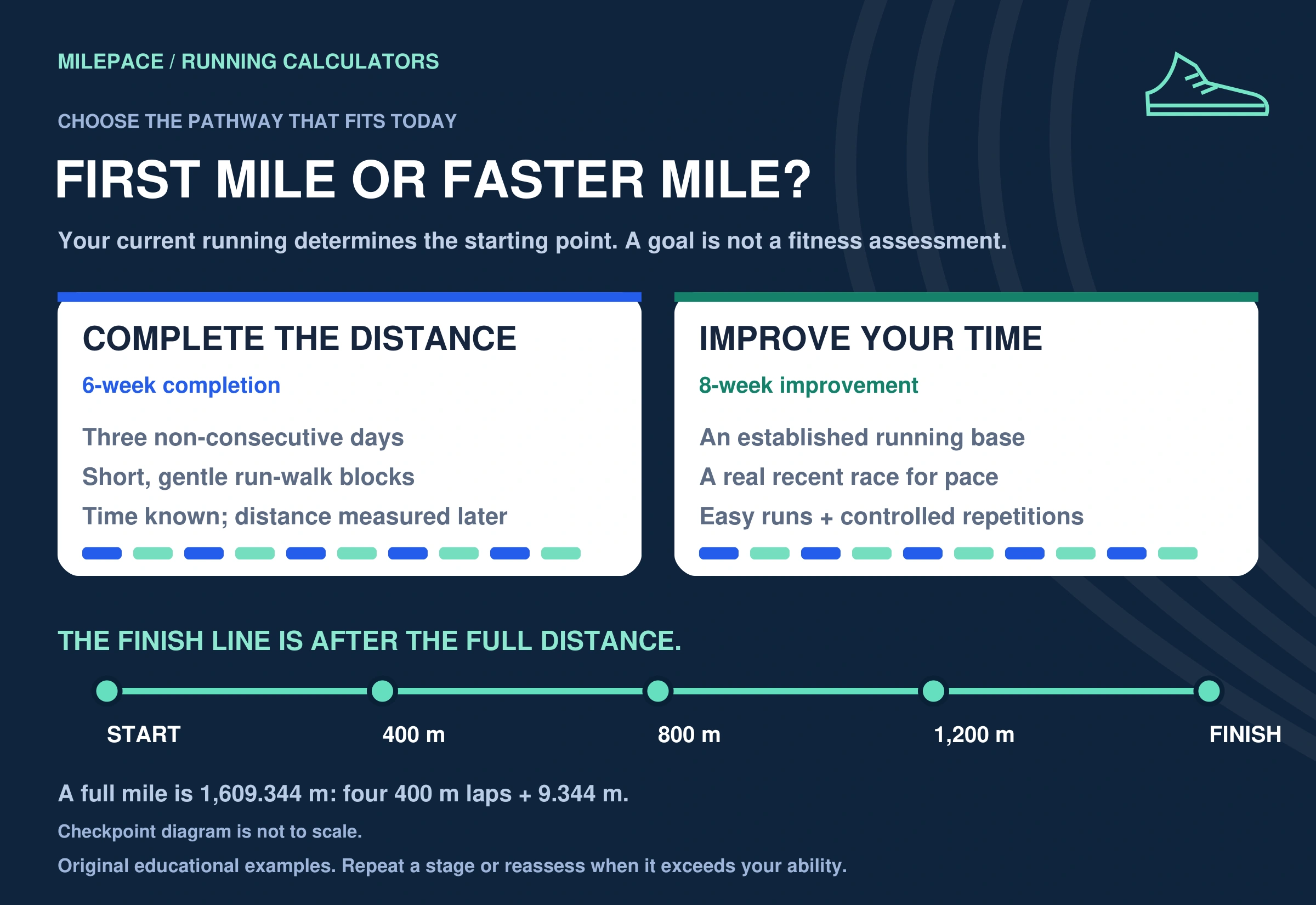
If your main aim is completing a continuous mile, the completion pathway gives you short jogs and walking breaks to work from. For improvement, you need regular running weeks and a recent race result so your starting workload and training paces reflect what you can do now. Your desired finish time comes later in that decision.
| Pathway | Starting ability | Example length |
|---|---|---|
| First-mile completion | Comfortable walking for about 30 minutes, with the ability to attempt the first short gentle jogs | 6 weeks, 3 non-consecutive run-walk days |
| Mile improvement | An established running routine, at least 16 km per week, a recent 4 km long run and a recent race result | 8 weeks; example uses 4 running days |
The improvement example below starts at 10 miles per week with a recent 3.5-mile long run, while the table shows the minimum inputs this particular template accepts.
Those are our template entry limits, rather than universal readiness standards. For instance, if your representative week is higher than the example’s mileage, your own schedule should start from that actual routine.
Run Wales separates first-mile preparation from later improvement plans and explains that a programme can be adjusted to suit the runner. The schedules on this page are original examples, and no coach has reviewed them for your individual circumstances.
A six-week beginner mile training schedule
The first-mile example gives you three non-consecutive run-walk days, with short early jogs and a recovery day between sessions. You can open each week below to see exactly what it contains.
Also, the five-minute opening and closing walks are already included in the listed time, which makes it easier to see how long your whole session will take.
For instance, the first session has six one-minute jogs, five 90-second walks between them, and the opening and closing walks. Altogether, that’s 23 minutes 30 seconds.
Your distance depends on how fast you walk and jog, so you’ll see a time here and can add a measured distance to your record afterward.
Example schedule: 1 Mile Completion Schedule. Days below are relative to the example week. Use the builder for your actual dates.
Week 1 · Extend running only when comfortable · 70.5 scheduled training minutes
| Day | Session | Distance or time | How to do it |
|---|---|---|---|
| Mon | Easy run-walk intervals | 23.5 min | Walk 5 minutes to start. 6 × 1 min gentle running, with 1.5 min walking between running bouts. Walk 5 minutes to finish. Repeat an earlier week if this is too demanding. Distance is unknown until measured. Easy enough to speak comfortably; walk as needed. |
| Tue | Rest | Rest | Take the day off. Do not add missed mileage to the next session. No scheduled workout. |
| Wed | Easy run-walk intervals | 23.5 min | Walk 5 minutes to start. 6 × 1 min gentle running, with 1.5 min walking between running bouts. Walk 5 minutes to finish. Repeat an earlier week if this is too demanding. Distance is unknown until measured. Easy enough to speak comfortably; walk as needed. |
| Thu | Rest | Rest | Take the day off. Do not add missed mileage to the next session. No scheduled workout. |
| Fri | Rest | Rest | Take the day off. Do not add missed mileage to the next session. No scheduled workout. |
| Sat | Easy run-walk intervals | 23.5 min | Walk 5 minutes to start. 6 × 1 min gentle running, with 1.5 min walking between running bouts. Walk 5 minutes to finish. Repeat an earlier week if this is too demanding. Distance is unknown until measured. Easy enough to speak comfortably; walk as needed. |
| Sun | Rest | Rest | Take the day off. Do not add missed mileage to the next session. No scheduled workout. |
Week 2 · Extend running only when comfortable · 79.5 scheduled training minutes
| Day | Session | Distance or time | How to do it |
|---|---|---|---|
| Mon | Easy run-walk intervals | 26.5 min | Walk 5 minutes to start. 6 × 1.5 min gentle running, with 1.5 min walking between running bouts. Walk 5 minutes to finish. Repeat an earlier week if this is too demanding. Distance is unknown until measured. Easy enough to speak comfortably; walk as needed. |
| Tue | Rest | Rest | Take the day off. Do not add missed mileage to the next session. No scheduled workout. |
| Wed | Easy run-walk intervals | 26.5 min | Walk 5 minutes to start. 6 × 1.5 min gentle running, with 1.5 min walking between running bouts. Walk 5 minutes to finish. Repeat an earlier week if this is too demanding. Distance is unknown until measured. Easy enough to speak comfortably; walk as needed. |
| Thu | Rest | Rest | Take the day off. Do not add missed mileage to the next session. No scheduled workout. |
| Fri | Rest | Rest | Take the day off. Do not add missed mileage to the next session. No scheduled workout. |
| Sat | Easy run-walk intervals | 26.5 min | Walk 5 minutes to start. 6 × 1.5 min gentle running, with 1.5 min walking between running bouts. Walk 5 minutes to finish. Repeat an earlier week if this is too demanding. Distance is unknown until measured. Easy enough to speak comfortably; walk as needed. |
| Sun | Rest | Rest | Take the day off. Do not add missed mileage to the next session. No scheduled workout. |
Week 3 · Extend running only when comfortable · 79.5 scheduled training minutes
| Day | Session | Distance or time | How to do it |
|---|---|---|---|
| Mon | Easy run-walk intervals | 26.5 min | Walk 5 minutes to start. 4 × 3 min gentle running, with 1.5 min walking between running bouts. Walk 5 minutes to finish. Repeat an earlier week if this is too demanding. Distance is unknown until measured. Easy enough to speak comfortably; walk as needed. |
| Tue | Rest | Rest | Take the day off. Do not add missed mileage to the next session. No scheduled workout. |
| Wed | Easy run-walk intervals | 26.5 min | Walk 5 minutes to start. 4 × 3 min gentle running, with 1.5 min walking between running bouts. Walk 5 minutes to finish. Repeat an earlier week if this is too demanding. Distance is unknown until measured. Easy enough to speak comfortably; walk as needed. |
| Thu | Rest | Rest | Take the day off. Do not add missed mileage to the next session. No scheduled workout. |
| Fri | Rest | Rest | Take the day off. Do not add missed mileage to the next session. No scheduled workout. |
| Sat | Easy run-walk intervals | 26.5 min | Walk 5 minutes to start. 4 × 3 min gentle running, with 1.5 min walking between running bouts. Walk 5 minutes to finish. Repeat an earlier week if this is too demanding. Distance is unknown until measured. Easy enough to speak comfortably; walk as needed. |
| Sun | Rest | Rest | Take the day off. Do not add missed mileage to the next session. No scheduled workout. |
Week 4 · Extend running only when comfortable · 84 scheduled training minutes
| Day | Session | Distance or time | How to do it |
|---|---|---|---|
| Mon | Easy run-walk intervals | 28 min | Walk 5 minutes to start. 2 × 8 min gentle running, with 2 min walking between running bouts. Walk 5 minutes to finish. Repeat an earlier week if this is too demanding. Distance is unknown until measured. Easy enough to speak comfortably; walk as needed. |
| Tue | Rest | Rest | Take the day off. Do not add missed mileage to the next session. No scheduled workout. |
| Wed | Easy run-walk intervals | 28 min | Walk 5 minutes to start. 2 × 8 min gentle running, with 2 min walking between running bouts. Walk 5 minutes to finish. Repeat an earlier week if this is too demanding. Distance is unknown until measured. Easy enough to speak comfortably; walk as needed. |
| Thu | Rest | Rest | Take the day off. Do not add missed mileage to the next session. No scheduled workout. |
| Fri | Rest | Rest | Take the day off. Do not add missed mileage to the next session. No scheduled workout. |
| Sat | Easy run-walk intervals | 28 min | Walk 5 minutes to start. 2 × 8 min gentle running, with 2 min walking between running bouts. Walk 5 minutes to finish. Repeat an earlier week if this is too demanding. Distance is unknown until measured. Easy enough to speak comfortably; walk as needed. |
| Sun | Rest | Rest | Take the day off. Do not add missed mileage to the next session. No scheduled workout. |
Week 5 · Extend running only when comfortable · 105 scheduled training minutes
| Day | Session | Distance or time | How to do it |
|---|---|---|---|
| Mon | Comfortable continuous running | 35 min | Walk 5 minutes to start. 1 × 25 min gentle running. Walk 5 minutes to finish. Repeat an earlier week if this is too demanding. Distance is unknown until measured. Easy enough to speak comfortably; walk as needed. |
| Tue | Rest | Rest | Take the day off. Do not add missed mileage to the next session. No scheduled workout. |
| Wed | Comfortable continuous running | 35 min | Walk 5 minutes to start. 1 × 25 min gentle running. Walk 5 minutes to finish. Repeat an earlier week if this is too demanding. Distance is unknown until measured. Easy enough to speak comfortably; walk as needed. |
| Thu | Rest | Rest | Take the day off. Do not add missed mileage to the next session. No scheduled workout. |
| Fri | Rest | Rest | Take the day off. Do not add missed mileage to the next session. No scheduled workout. |
| Sat | Comfortable continuous running | 35 min | Walk 5 minutes to start. 1 × 25 min gentle running. Walk 5 minutes to finish. Repeat an earlier week if this is too demanding. Distance is unknown until measured. Easy enough to speak comfortably; walk as needed. |
| Sun | Rest | Rest | Take the day off. Do not add missed mileage to the next session. No scheduled workout. |
Week 6 · Event week · 40 scheduled training minutes; event 1.609 km separately
| Day | Session | Distance or time | How to do it |
|---|---|---|---|
| Mon | Short easy run-walk | 20 min | Walk 5 minutes, jog easily 10 minutes with walking breaks as needed, walk 5 minutes. Keep this lighter than your established sessions. Easy enough to speak comfortably; walk as needed. |
| Tue | Rest | Rest | Take the day off. Do not add missed mileage to the next session. No scheduled workout. |
| Wed | Short easy run-walk | 20 min | Walk 5 minutes, jog easily 10 minutes with walking breaks as needed, walk 5 minutes. Keep this lighter than your established sessions. Easy enough to speak comfortably; walk as needed. |
| Thu | Rest | Rest | Take the day off. Do not add missed mileage to the next session. No scheduled workout. |
| Fri | Rest | Rest | Take the day off. Do not add missed mileage to the next session. No scheduled workout. |
| Sat | Rest | Rest | Take the day off. Do not add missed mileage to the next session. No scheduled workout. |
| Sun | 1 Mile event or assessment | 1.609 km | This is the event distance, not a forecast. Enter only if your preparation and recovery support it. Warm-up and cool-down are not assigned a distance here; record them separately if completed. The event may fall outside your ordinary training weekdays. Completion at a manageable effort, with walking if needed. |
You can repeat a week when the next one feels too demanding. The NHS beginner-running guidance also uses run-walk practice and allows a longer completion timeline. Its programme is separate from this original mile example.
Your final mile is a chance to measure what you can manage then, including walking breaks if you need them. If you’re still finding a continuous mile difficult, you can keep working at a comfortable stage and choose a later assessment date. A completed-distance record is still useful when part of the effort is walked.
An eight-week schedule for running a faster mile
The improvement example combines easy running, an easy long run and controlled short repetitions. It starts from a representative ten-mile week, a recent 3.5-mile long run and a 25:00 5K used only as an example pace basis.
Your own recent result should replace that pace basis in the builder.
Each quality session includes its work distance, recovery and easy running, so you can check the whole workout before you begin. For example, four repetitions have three rests between them.
The one-kilometer warm-up and one-kilometer cool-down already count toward the total distance, together with any additional easy running listed in the description.
Example schedule: 1 Mile Improvement Schedule. Days below are relative to the example week. Use the builder for your actual dates.
Week 1 · Gradual build · 10.00 mi / 16.09 km training
| Day | Session | Distance or time | How to do it |
|---|---|---|---|
| Mon | Rest | Rest | Take the day off. Do not add missed mileage to the next session. No scheduled workout. |
| Tue | Easy conversational run | 3.486 km | The stated distance includes your easy start and finish. Keep the whole run comfortable. Walk breaks are allowed; shorten or repeat the week if recovery is poor. No finish time is guaranteed. 9:44–11:38/mi (modeled current-fitness reference) |
| Wed | Rest | Rest | Take the day off. Do not add missed mileage to the next session. No scheduled workout. |
| Thu | Easy conversational run | 3.486 km | The stated distance includes your easy start and finish. Keep the whole run comfortable. Walk breaks are allowed; shorten or repeat the week if recovery is poor. No finish time is guaranteed. 9:44–11:38/mi (modeled current-fitness reference) |
| Fri | Rest | Rest | Take the day off. Do not add missed mileage to the next session. No scheduled workout. |
| Sat | Easy conversational run | 3.488 km | The stated distance includes your easy start and finish. Keep the whole run comfortable. Walk breaks are allowed; shorten or repeat the week if recovery is poor. No finish time is guaranteed. 9:44–11:38/mi (modeled current-fitness reference) |
| Sun | Easy long run | 5.633 km | The stated distance includes your easy start and finish. Keep the whole run comfortable. Walk breaks are allowed; shorten or repeat the week if recovery is poor. No finish time is guaranteed. 9:44–11:38/mi (modeled current-fitness reference) |
Week 2 · Gradual build · 10.42 mi / 16.76 km training
| Day | Session | Distance or time | How to do it |
|---|---|---|---|
| Mon | Rest | Rest | Take the day off. Do not add missed mileage to the next session. No scheduled workout. |
| Tue | Controlled short repetitions | 3.632 km | 1 km easy warm-up; 3 × 200 m controlled work with 90 seconds stationary rest between bouts (2 rests); 1 km easy cool-down; 1.03 km additional easy running. 600 m work is included in the 3.63 km session. Slow down or stop the work bouts if effort or form deteriorates. Work: 7:24/mi (modeled current-fitness reference). Rest between bouts; easy running by conversation. |
| Wed | Rest | Rest | Take the day off. Do not add missed mileage to the next session. No scheduled workout. |
| Thu | Easy conversational run | 3.632 km | The stated distance includes your easy start and finish. Keep the whole run comfortable. Walk breaks are allowed; shorten or repeat the week if recovery is poor. No finish time is guaranteed. 9:44–11:38/mi (modeled current-fitness reference) |
| Fri | Rest | Rest | Take the day off. Do not add missed mileage to the next session. No scheduled workout. |
| Sat | Easy conversational run | 3.633 km | The stated distance includes your easy start and finish. Keep the whole run comfortable. Walk breaks are allowed; shorten or repeat the week if recovery is poor. No finish time is guaranteed. 9:44–11:38/mi (modeled current-fitness reference) |
| Sun | Easy long run | 5.867 km | The stated distance includes your easy start and finish. Keep the whole run comfortable. Walk breaks are allowed; shorten or repeat the week if recovery is poor. No finish time is guaranteed. 9:44–11:38/mi (modeled current-fitness reference) |
Week 3 · Gradual build · 10.83 mi / 17.44 km training
| Day | Session | Distance or time | How to do it |
|---|---|---|---|
| Mon | Rest | Rest | Take the day off. Do not add missed mileage to the next session. No scheduled workout. |
| Tue | Controlled short repetitions | 3.777 km | 1 km easy warm-up; 3 × 200 m controlled work with 90 seconds stationary rest between bouts (2 rests); 1 km easy cool-down; 1.18 km additional easy running. 600 m work is included in the 3.78 km session. Slow down or stop the work bouts if effort or form deteriorates. Work: 7:24/mi (modeled current-fitness reference). Rest between bouts; easy running by conversation. |
| Wed | Rest | Rest | Take the day off. Do not add missed mileage to the next session. No scheduled workout. |
| Thu | Easy conversational run | 3.777 km | The stated distance includes your easy start and finish. Keep the whole run comfortable. Walk breaks are allowed; shorten or repeat the week if recovery is poor. No finish time is guaranteed. 9:44–11:38/mi (modeled current-fitness reference) |
| Fri | Rest | Rest | Take the day off. Do not add missed mileage to the next session. No scheduled workout. |
| Sat | Easy conversational run | 3.779 km | The stated distance includes your easy start and finish. Keep the whole run comfortable. Walk breaks are allowed; shorten or repeat the week if recovery is poor. No finish time is guaranteed. 9:44–11:38/mi (modeled current-fitness reference) |
| Sun | Easy long run | 6.102 km | The stated distance includes your easy start and finish. Keep the whole run comfortable. Walk breaks are allowed; shorten or repeat the week if recovery is poor. No finish time is guaranteed. 9:44–11:38/mi (modeled current-fitness reference) |
Week 4 · Step-back week · 9.56 mi / 15.39 km training
| Day | Session | Distance or time | How to do it |
|---|---|---|---|
| Mon | Rest | Rest | Take the day off. Do not add missed mileage to the next session. No scheduled workout. |
| Tue | Easy conversational run | 3.334 km | The stated distance includes your easy start and finish. Keep the whole run comfortable. Walk breaks are allowed; shorten or repeat the week if recovery is poor. No finish time is guaranteed. 9:44–11:38/mi (modeled current-fitness reference) |
| Wed | Rest | Rest | Take the day off. Do not add missed mileage to the next session. No scheduled workout. |
| Thu | Easy conversational run | 3.334 km | The stated distance includes your easy start and finish. Keep the whole run comfortable. Walk breaks are allowed; shorten or repeat the week if recovery is poor. No finish time is guaranteed. 9:44–11:38/mi (modeled current-fitness reference) |
| Fri | Rest | Rest | Take the day off. Do not add missed mileage to the next session. No scheduled workout. |
| Sat | Easy conversational run | 3.335 km | The stated distance includes your easy start and finish. Keep the whole run comfortable. Walk breaks are allowed; shorten or repeat the week if recovery is poor. No finish time is guaranteed. 9:44–11:38/mi (modeled current-fitness reference) |
| Sun | Easy long run | 5.386 km | The stated distance includes your easy start and finish. Keep the whole run comfortable. Walk breaks are allowed; shorten or repeat the week if recovery is poor. No finish time is guaranteed. 9:44–11:38/mi (modeled current-fitness reference) |
Week 5 · Gradual build · 11.67 mi / 18.78 km training
| Day | Session | Distance or time | How to do it |
|---|---|---|---|
| Mon | Rest | Rest | Take the day off. Do not add missed mileage to the next session. No scheduled workout. |
| Tue | Controlled short repetitions | 4.068 km | 1 km easy warm-up; 4 × 200 m controlled work with 90 seconds stationary rest between bouts (3 rests); 1 km easy cool-down; 1.27 km additional easy running. 800 m work is included in the 4.07 km session. Slow down or stop the work bouts if effort or form deteriorates. Work: 7:24/mi (modeled current-fitness reference). Rest between bouts; easy running by conversation. |
| Wed | Rest | Rest | Take the day off. Do not add missed mileage to the next session. No scheduled workout. |
| Thu | Easy conversational run | 4.068 km | The stated distance includes your easy start and finish. Keep the whole run comfortable. Walk breaks are allowed; shorten or repeat the week if recovery is poor. No finish time is guaranteed. 9:44–11:38/mi (modeled current-fitness reference) |
| Fri | Rest | Rest | Take the day off. Do not add missed mileage to the next session. No scheduled workout. |
| Sat | Easy conversational run | 4.069 km | The stated distance includes your easy start and finish. Keep the whole run comfortable. Walk breaks are allowed; shorten or repeat the week if recovery is poor. No finish time is guaranteed. 9:44–11:38/mi (modeled current-fitness reference) |
| Sun | Easy long run | 6.571 km | The stated distance includes your easy start and finish. Keep the whole run comfortable. Walk breaks are allowed; shorten or repeat the week if recovery is poor. No finish time is guaranteed. 9:44–11:38/mi (modeled current-fitness reference) |
Week 6 · Gradual build · 12.08 mi / 19.45 km training
| Day | Session | Distance or time | How to do it |
|---|---|---|---|
| Mon | Rest | Rest | Take the day off. Do not add missed mileage to the next session. No scheduled workout. |
| Tue | Controlled short repetitions | 4.213 km | 1 km easy warm-up; 4 × 200 m controlled work with 90 seconds stationary rest between bouts (3 rests); 1 km easy cool-down; 1.41 km additional easy running. 800 m work is included in the 4.21 km session. Slow down or stop the work bouts if effort or form deteriorates. Work: 7:24/mi (modeled current-fitness reference). Rest between bouts; easy running by conversation. |
| Wed | Rest | Rest | Take the day off. Do not add missed mileage to the next session. No scheduled workout. |
| Thu | Easy conversational run | 4.213 km | The stated distance includes your easy start and finish. Keep the whole run comfortable. Walk breaks are allowed; shorten or repeat the week if recovery is poor. No finish time is guaranteed. 9:44–11:38/mi (modeled current-fitness reference) |
| Fri | Rest | Rest | Take the day off. Do not add missed mileage to the next session. No scheduled workout. |
| Sat | Easy conversational run | 4.214 km | The stated distance includes your easy start and finish. Keep the whole run comfortable. Walk breaks are allowed; shorten or repeat the week if recovery is poor. No finish time is guaranteed. 9:44–11:38/mi (modeled current-fitness reference) |
| Sun | Easy long run | 6.806 km | The stated distance includes your easy start and finish. Keep the whole run comfortable. Walk breaks are allowed; shorten or repeat the week if recovery is poor. No finish time is guaranteed. 9:44–11:38/mi (modeled current-fitness reference) |
Week 7 · Gradual build · 12.50 mi / 20.12 km training
| Day | Session | Distance or time | How to do it |
|---|---|---|---|
| Mon | Rest | Rest | Take the day off. Do not add missed mileage to the next session. No scheduled workout. |
| Tue | Controlled short repetitions | 4.358 km | 1 km easy warm-up; 5 × 200 m controlled work with 90 seconds stationary rest between bouts (4 rests); 1 km easy cool-down; 1.36 km additional easy running. 1000 m work is included in the 4.36 km session. Slow down or stop the work bouts if effort or form deteriorates. Work: 7:24/mi (modeled current-fitness reference). Rest between bouts; easy running by conversation. |
| Wed | Rest | Rest | Take the day off. Do not add missed mileage to the next session. No scheduled workout. |
| Thu | Easy conversational run | 4.358 km | The stated distance includes your easy start and finish. Keep the whole run comfortable. Walk breaks are allowed; shorten or repeat the week if recovery is poor. No finish time is guaranteed. 9:44–11:38/mi (modeled current-fitness reference) |
| Fri | Rest | Rest | Take the day off. Do not add missed mileage to the next session. No scheduled workout. |
| Sat | Easy conversational run | 4.360 km | The stated distance includes your easy start and finish. Keep the whole run comfortable. Walk breaks are allowed; shorten or repeat the week if recovery is poor. No finish time is guaranteed. 9:44–11:38/mi (modeled current-fitness reference) |
| Sun | Easy long run | 7.041 km | The stated distance includes your easy start and finish. Keep the whole run comfortable. Walk breaks are allowed; shorten or repeat the week if recovery is poor. No finish time is guaranteed. 9:44–11:38/mi (modeled current-fitness reference) |
Week 8 · Event week · 2.25 mi / 3.62 km training; event 1.609 km separately
| Day | Session | Distance or time | How to do it |
|---|---|---|---|
| Mon | Rest | Rest | Take the day off. Do not add missed mileage to the next session. No scheduled workout. |
| Tue | Easy conversational run | 1.810 km | The stated distance includes your easy start and finish. Keep the whole run comfortable. Walk breaks are allowed; shorten or repeat the week if recovery is poor. No finish time is guaranteed. 9:44–11:38/mi (modeled current-fitness reference) |
| Wed | Rest | Rest | Take the day off. Do not add missed mileage to the next session. No scheduled workout. |
| Thu | Easy conversational run | 1.811 km | The stated distance includes your easy start and finish. Keep the whole run comfortable. Walk breaks are allowed; shorten or repeat the week if recovery is poor. No finish time is guaranteed. 9:44–11:38/mi (modeled current-fitness reference) |
| Fri | Rest | Rest | Take the day off. Do not add missed mileage to the next session. No scheduled workout. |
| Sat | Rest | Rest | Take the day off. Do not add missed mileage to the next session. No scheduled workout. |
| Sun | 1 Mile event or assessment | 1.609 km | This is the event distance, not a forecast. Enter only if your preparation and recovery support it. Warm-up and cool-down are not assigned a distance here; record them separately if completed. The event may fall outside your ordinary training weekdays. Use demonstrated fitness and conditions to choose your effort. |
The Training Pace Calculator explains the current-fitness model and lets you inspect a workout separately.
If your goal is a 7:00 mile, your easy running still needs to feel comfortable; entering that target by itself tells us little about your present training pace. Your recent result supplies the modeled reference, and your effort and conditions help you judge it on the day.
The example includes step-back weeks and lighter training near the assessment, with the exact progression chosen for this original educational template. You can leave the optional goal time blank. That way, your final measured mile gives you a result to review without treating a particular improvement as something the schedule has promised.
How to turn a mile goal into exact track splits
A full mile is 1,609.344 meters, which puts your finish another 9.344 meters beyond four laps of a 400-meter track. That small difference matters when you’re checking a timed result. The table uses measured 400-meter checkpoints, and the final mile time includes the extra distance after the fourth lap.

| Mile goal | 400 m | 800 m | 1,200 m | 1,600 m |
|---|---|---|---|---|
| 6:00.0 | 1:29.5 | 2:59.0 | 4:28.4 | 5:57.9 |
| 7:00.0 | 1:44.4 | 3:28.8 | 5:13.2 | 6:57.6 |
| 8:00.0 | 1:59.3 | 3:58.6 | 5:57.9 | 7:57.2 |
| 10:00.0 | 2:29.1 | 4:58.3 | 7:27.4 | 9:56.5 |
For an 8:00 mile, for instance, you’ll reach 400 meters in about 1:59.3 and 1,600 meters in about 7:57.2. The last 9.344 meters takes another 2.8 seconds at that pace.
Four equal two-minute laps would bring you to 1,600 meters at eight minutes, with the mile finish still ahead.
The Track Pace Calculator handles the exact finish and partial lap. You can compare the planned checkpoints with what you actually ran, then review a measured effort rather than relying on an approximate watch distance.
How to adjust the plan when a week goes wrong
If you miss a session, you can leave it out or repeat a comfortable week and keep the recovery space around your next run. Adding several missed runs to the following days changes the workload the schedule was built around. After a longer interruption, your recent routine is the more useful starting point for deciding where to restart.
The builder keeps the final two days before the event free of scheduled training. It also checks that its quality day and preferred long day have a calendar day between them. Moving an interval session into that gap would change the arrangement, even if the weekly mileage stayed the same.
The examples use original progression and step-back choices, with no single percentage increase presented as an injury-prevention rule. Jack Daniels discusses frequency, amount, intensity and recovery as separate training variables, which helps explain why changing the recoveries can change the workout even when its mileage stays the same. That general principle is separate from validating an exact schedule for you.
When you want to put the example on your calendar, the Running Training Plan Builder for a mile lets you enter your real dates and starting routine. You can review the assumptions, check the first session, and save a copy in My Mile.
Records stay in this browser, so a downloaded JSON backup is useful before switching devices or clearing site data.
Frequently Asked Questions
Can I follow the mile plan on a treadmill?
You can use a treadmill for the listed easy running and timed sessions. A treadmill’s displayed distance and belt speed may differ from an outdoor measured course. If your assessment takes place outside, check that course and its timing arrangements before using a treadmill result as your benchmark.
Can I take more than six weeks to run my first mile?
Yes. Repeat a stage when you need more time, and choose a later assessment date. The calendar is a way to organize practice, so completing a week slowly is more useful than forcing sessions that exceed your present ability.
Does the eight-week plan promise a sub-six-minute mile?
No. The schedule doesn’t establish an individual improvement rate. A sub-six-minute target means holding under six minutes for the full measured mile, and your recent performance is a better starting point for choosing training pace than that desired result.
Can I save the plan without an account?
Yes, you can save a schedule to My Mile in this browser without creating an account. A plan JSON contains the schedule itself, while My Mile’s JSON backup includes your saved records.
To move those records to another device, you’ll need the appropriate exported file because the site has no cloud synchronization.