

Mile Pace Converter
This pace converter changes minutes per mile to minutes per kilometer, MPH, km/h and miles per minute. You can also enter a speed to find your running pace, while the tables below give you common mile and kilometer paces and the time needed to cover ten miles.
Your Known Pace or Speed
Explore A Different Pace
Move left for a faster pace, right for a slower pace. This changes your input.
Your kilometer pace
MIN / KMEnter a pace or try an example to see your conversion.
Advanced equivalents
Your Speed On The Scale

Your inputs stay in your browser.
Finish Times at This Pace
See how long common track and road distances take when the converted pace stays constant.
| Distance | Finish time |
|---|
These are mathematical constant-speed estimates, not race-performance predictions. Hills, weather, fatigue and course conditions can change an actual finish time.
Compare Nearby Paces
Compare changes of 15 and 30 seconds in your input unit.
| Change | Min / Mile | Min / Km | MPH | Km / H | Mi / Min |
|---|
Paces round to the nearest second (hundredths below 10 seconds); mph and km/h round to two decimals; mi/min uses up to six decimals. Lap times round to seconds. Calculations and unit swaps retain the unrounded pace.
Running Pace Conversion Chart
Compare mile pace, kilometer pace, MPH, km/h and miles per minute across a full range. Change the range or interval, then print the chart, save it as a PDF or download its rows as CSV.
Open Interactive Pace Conversion Chart
| Min / Mile | Min / Km | MPH | Km / H | Mi / Min |
|---|
Values are constant-speed equivalents, not predicted race performances. Printed charts can be saved as PDF using your browser’s print dialog.
How the pace converter changes min/mile to min/km
To convert min/mile to min/km, divide your time per mile by 1.609344. For a kilometer-to-mile pace conversion, you multiply by the same number, and although you can do this with decimal minutes, using seconds first makes it easier to keep the clock format correct.
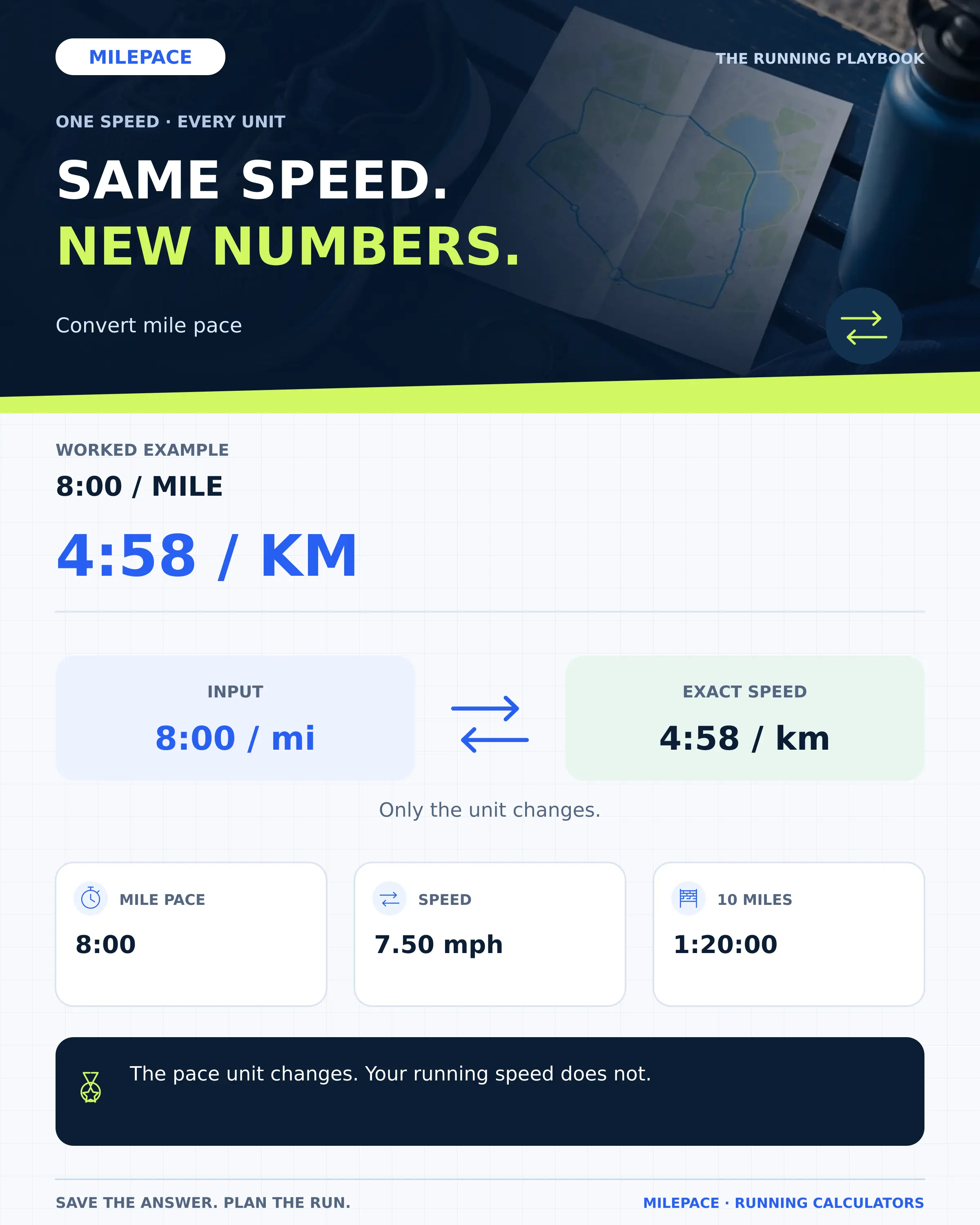
For instance, an eight-minute mile contains 480 seconds. Dividing 480 by 1.609344 gives about 298.26 seconds, so your pace becomes 4:58 per kilometer after rounding. You are covering a shorter distance in that time, which is why the number gets smaller even though your speed stays the same.
Seconds per kilometer = seconds per mile ÷ 1.609344
Seconds per mile = seconds per kilometer × 1.609344
The NIST conversion factors give the international mile as exactly 1.609344 kilometers. That relationship also lets you convert miles per hour to kilometers per hour: multiply MPH by 1.609344. All the tables here use the full factor before rounding the displayed answer.
A mile-to-kilometer pace converter changes time per distance. If you just need to convert a distance, such as 1.5 miles into kilometers, you can use the Miles to KM Converter instead.
Common mile pace conversions
An 8-minute mile in km pace is 4:58/km, while a 7-minute mile converts to 4:21/km. You can compare those with a 9-minute mile at 5:36/km in the table below, where each row shows the same speed in four units for your watch or training plan.
| Minutes per mile | Minutes per km | MPH | Km/h |
|---|---|---|---|
| 5:00 | 3:06 | 12.00 | 19.31 |
| 6:00 | 3:44 | 10.00 | 16.09 |
| 7:00 | 4:21 | 8.57 | 13.79 |
| 7:30 | 4:40 | 8.00 | 12.87 |
| 8:00 | 4:58 | 7.50 | 12.07 |
| 8:30 | 5:17 | 7.06 | 11.36 |
| 9:00 | 5:36 | 6.67 | 10.73 |
| 9:30 | 5:54 | 6.32 | 10.16 |
| 10:00 | 6:13 | 6.00 | 9.66 |
| 11:00 | 6:50 | 5.45 | 8.78 |
| 12:00 | 7:27 | 5.00 | 8.05 |
Also, half-minute paces have their own rows in the table. A 7:30 mile pace is 4:40/km and 8 mph; an 8:30 mile pace is 5:17/km and about 7.06 mph. At 9:30 per mile, your kilometer pace is 5:54 and your speed is about 6.32 mph.
If you’re looking for a five-minute mile in kilometers, your equivalent pace is 3:06/km. A six-minute mile is 3:44/km, ten minutes per mile is 6:13/km, eleven is 6:50/km, and twelve is 7:27/km. The table gives you a quick reference; you can enter your exact seconds above when your pace falls between the listed values.
Convert min/km to min/mile
For a km-to-mile pace conversion, multiply seconds per kilometer by 1.609344. For instance, 5 min/km is about 8:03 per mile, while 4 min/km is 6:26 per mile. The reverse table starts with the kilometer pace so you can read across from the unit you already use.
| Minutes per km | Minutes per mile | MPH | Km/h |
|---|---|---|---|
| 4:00 | 6:26 | 9.32 | 15.00 |
| 5:00 | 8:03 | 7.46 | 12.00 |
| 6:00 | 9:39 | 6.21 | 10.00 |
| 7:00 | 11:16 | 5.33 | 8.57 |
| 8:00 | 12:52 | 4.66 | 7.50 |
| 10:00 | 16:06 | 3.73 | 6.00 |
A 6:00/km pace in miles is about 9:39/mile, while a plan asking you to run at seven minutes per kilometer would mean 11:16/mile, and eight minutes per kilometer would mean 12:52/mile. And ten minutes per kilometer converts to 16:06/mile, with the same relationship applying if you’re walking.
However, if you searched for “6km pace in miles,” the six could mean either six minutes per kilometer or a six-kilometer run. This table assumes 6:00 per kilometer. The distance alone doesn’t tell you a pace; you’d also need the time you took to cover it.
Convert MPH and km/h into running pace
To convert MPH to minutes per mile, divide 60 by the speed, or if you need minutes per kilometer from km/h, divide 60 by that speed instead. Your answer is in decimal minutes, which you can turn into minutes and seconds before using it as a running pace.
For instance, if you run at 8 mph, your mile time is 7:30: 60 divided by eight gives 7.5 minutes. At 7.5 mph, a mile takes 8:00 and the equivalent speed is 12.07 km/h. The table includes slower speeds as well, so you can use it for a walking pace or a treadmill setting.
| Speed (MPH) | Time for one mile | Pace per km | Speed (km/h) |
|---|---|---|---|
| 2.5 | 24:00 | 14:55 | 4.02 |
| 3.6 | 16:40 | 10:21 | 5.79 |
| 5 | 12:00 | 7:27 | 8.05 |
| 6 | 10:00 | 6:13 | 9.66 |
| 7.5 | 8:00 | 4:58 | 12.07 |
| 8 | 7:30 | 4:40 | 12.87 |
A 3.6 mph speed gives 16:40 per mile, and 2.5 mph gives 24:00. At 5 mph, your mile time is 12:00. You can use these times to read your speed in a different unit, with your actual walking or running effort depending on the conditions.
Convert minutes per mile to MPH
A 10-minute mile is 6 mph, and a seven-minute mile is about 8.57 mph. And you can calculate either by dividing 60 by your pace in decimal minutes. A nine-minute mile gives about 6.67 mph, while an eleven-minute mile gives about 5.45 mph.
For a 9:30 pace, you’ll use 9.5 minutes in the formula, giving about 6.32 mph. If you’re choosing a belt setting and also need to work out distance or session time, the Treadmill Pace Calculator brings those inputs together.
Convert miles per minute to miles per hour
Multiply miles per minute by 60 to get miles per hour. A speed of 0.1 mi/min is 6 mph, which gives you a pace of 10:00 per mile, and you can check it in the miles-per-minute calculator by selecting that input unit.
At 0.125 miles per minute, you cover one eighth of a mile each minute. That works out to 7.5 mph, or 8:00 per mile. The results include mi/min when you start with another unit too, so you can convert in either direction.
| Miles per minute | Miles per hour | Minutes per mile |
|---|---|---|
| 0.05 | 3.00 | 20:00 |
| 0.1 | 6.00 | 10:00 |
| 0.125 | 7.50 | 8:00 |
| 0.2 | 12.00 | 5:00 |
MPH = miles per minute × 60
Miles per minute = MPH ÷ 60
Minutes per mile = 1 ÷ miles per minute
Be careful with the order of the units here. Miles per minute is speed; minutes per mile is pace. A value of 0.1 mile per minute means a mile takes ten minutes. It doesn’t mean you’re running a mile in 0.1 minute.
Miles per hour vs. minutes per 10 miles
At 6 mph, ten miles takes 100 minutes, or 1:40:00. Your pace is still 10:00 per mile, but minutes per ten miles describes the time for the whole ten-mile distance, so you multiply the minutes-per-mile value by ten.
Minutes for ten miles = 600 ÷ MPH
Minutes for ten miles = minutes per mile × 10
| Speed (MPH) | Pace per mile | Minutes for 10 miles | Clock finish time |
|---|---|---|---|
| 5 | 12:00 | 120 | 2:00:00 |
| 6 | 10:00 | 100 | 1:40:00 |
| 7.5 | 8:00 | 80 | 1:20:00 |
| 8 | 7:30 | 75 | 1:15:00 |
You can also read your ten-mile time directly in the calculator results. If you have a different distance in mind, use the custom-distance option in the main calculator linked below. These finish times assume you maintain the entered speed throughout.
Read minutes and seconds correctly
A pace of 8:30 means 8.5 decimal minutes, because 30 seconds is half a minute. If you enter 8.30 into a formula that expects decimal minutes, you’re using eight minutes and 18 seconds instead. That small change in how you write the number changes the result.
So you can avoid that problem by calculating in seconds: eight times 60 plus 30 gives 510 seconds. After converting the pace, divide the answer by 60 for whole minutes and use the remaining seconds for the clock display. In the calculator’s pace fields, you can simply enter eight under Minutes and 30 under Seconds.
The tables round paces to the nearest second and MPH and km/h to two decimal places. Miles per minute uses up to six decimal places in the interactive results. Your calculations keep the unrounded values until display, including when you switch units.
Use your converted pace
You can use the converted value in the unit your watch or plan needs: min/km for kilometer splits, min/mile for mile splits, or MPH for a treadmill displaying miles per hour. The interactive running pace conversion chart lets you compare a range of values and print the table, which can be useful when a training session includes several different paces.
Also, you can calculate a finish time by multiplying your pace by the distance in the matching unit. At 6:00/km, five kilometers takes 30 minutes. At 8:00/mile, five miles takes 40 minutes.
If you have distance and finish time rather than a known pace, the Mile Pace Calculator can calculate pace, time or distance and give you individual splits. A speed-to-pace conversion simply expresses the speed you entered; it doesn’t predict how your pace will change in a longer race.
Frequently Asked Questions
Can I convert a walking pace?
Yes. The same distance and time relationships apply to walking and running, so you can enter either pace. The converter doesn’t use an age or fitness category to change the answer.
Why is a lower pace number faster?
A lower min/mile or min/km value means you take less time to cover that distance. Speed works the other way around: more miles per hour or miles per minute means you cover more distance in the same time.
Why doesn’t converting a rounded table value back give the exact original pace?
The rounded value has already lost a small part of the original number. For instance, 8:00/mile becomes about 4:58.258/km, which the table displays as 4:58. Entering that rounded pace back can differ from converting the original unrounded value.
Does an equivalent pace mean the same effort outdoors and on a treadmill?
No. The conversion tells you the equivalent units for the speed you entered. It doesn’t measure the effect of a hill, belt calibration, weather or fatigue on your actual effort.